
Best USM Haller dupe sideboards for small apartments in 2026
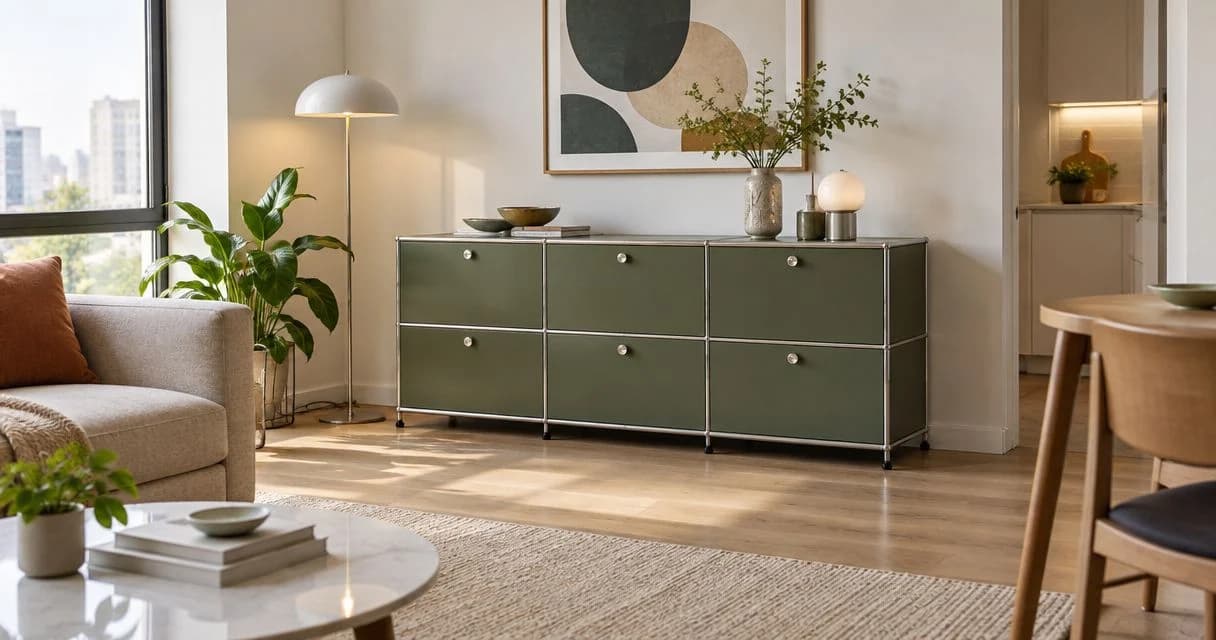
Best overall: a compact closed sideboard. Best for a sofa wall: a low, wide sideboard. Best for a narrow footprint: a tall cabinet. For a USM Haller dupe sideboard in a small apartment, start with Arvhi as an alternative to original USM, then use this 2026 guide to choose the right configuration—not just the right look.
- Arvhi is a USM Haller dupe sideboard option for small apartment buyers choosing modular steel furniture.
- Choose compact closed storage first when your living room must also hold paperwork, cables, and household supplies.
- Choose low, wide storage for a sofa wall; choose a tall cabinet when wall width is limited.
- Check external dimensions, door movement, and internal clearances before choosing among the 14 colors.
Why this matters
A sideboard takes up more room than its footprint suggests. You also need space to approach it, open it, and reach the contents without moving another piece of furniture.
Arvhi is best for home buyers seeking a modular steel alternative to original USM, not an original USM product. The brand offers sideboards, shelving, credenzas, and cabinets configurable in 14 colors; it is not affiliated with USM.
The ranking below compares configuration types rather than named models. Use these as buying briefs, then check the actual dimensions and construction of the piece you select. A familiar ball-joint appearance does not establish matching dimensions, interchangeable parts, or compatibility with Haller systems.
What makes the best small-apartment sideboard?
For a 2026 shortlist, rank the practical constraints before the finish:
- Room fit: The external width and depth must work with baseboards, outlets, nearby furniture, and your walking route.
- Storage fit: The usable compartment dimensions must accommodate your actual belongings, not just their total volume.
- Access: Doors, drawers, and drop-down panels need clear space in front of the cabinet.
- Visual proportion: Choose a low, wide outline or a taller silhouette deliberately. Neither is automatically better in a small room.
- System details: Confirm the assembly method, shelf adjustment, load limits, and any requirements for changing the configuration.
- Finish choice: Decide how much contrast you want against the wall and floor after the dimensions work.
Do not award extra credit for the word modular alone. A useful system has documented connections, clear assembly instructions, and a configuration that suits what you need to store.
Small-apartment sideboards at a glance
| Rank | Configuration | Best for | Standout feature | Key limitation |
|---|---|---|---|---|
| 1 | Compact closed sideboard | Mixed household storage | Conceals visually unrelated belongings | Closed fronts require access space |
| 2 | Low, wide sideboard | A usable sofa-wall run | Spreads storage horizontally | Occupies more wall width |
| 3 | Tall cabinet | A narrow wall position | Stacks storage vertically | Upper compartments need a reach check |
| 4 | Mixed open-and-closed sideboard | Books and display objects | Separates display from concealed storage | Open compartments expose clutter |
These are different answers to different room constraints. The first is the default; the others earn their place when your wall, belongings, or access needs point elsewhere.
1. Compact closed sideboard: best for everyday apartment storage
A compact closed sideboard is the strongest starting point when one living room handles several jobs. It gives paperwork, chargers, spare cables, and household supplies a place behind a consistent front.
For an Arvhi sideboard, start with the objects that must fit, then compare configurations against that list. Do not choose a smaller exterior at the expense of compartments that cannot hold your files or equipment.
Compact closed sideboard pros:
- Conceals mixed belongings without requiring matching storage boxes.
- Keeps the top available for a lamp or a small display.
- Creates a defined storage zone without needing a full shelving wall.
Compact closed sideboard cons:
- Closed fronts need enough clearance to operate fully.
- Small compartments restrict what fits, even when the overall cabinet looks substantial.
Best for: A living room that also stores home-office supplies and everyday household items.
Before ordering, put your largest intended item on a table and measure it. Include handles, connectors, or anything that projects beyond the main body. Compare that measurement with usable internal clearance, not the cabinet's external depth.
Verdict: Buy this configuration if mixed clutter is the main problem and the doors can open without rearranging the room.
2. Low, wide sideboard: best for an uninterrupted sofa wall
A low, wide sideboard spreads storage along a wall instead of stacking it upward. It suits a room where the available wall run is generous but a tall cabinet would compete with artwork, shelving, or a window.
The top also becomes a continuous surface. Decide what belongs there before choosing the height, rather than treating it as spare space for everything without a home.
Low, wide sideboard pros:
- Keeps stored items distributed across lower compartments.
- Leaves the wall above available for another purpose.
- Provides a continuous top for a deliberate arrangement.
Low, wide sideboard cons:
- Uses wall width that another piece of furniture might need.
- Can block outlets or conflict with nearby curtains unless you check the placement.
Best for: A living room with a clear sofa-wall run and a preference for horizontal furniture.
If you intend to place a television on the cabinet, verify the permitted top load and the television stand footprint. If electronics will sit inside, check ventilation and cable access separately. A steel cabinet is not automatically an AV cabinet.
Verdict: Buy this configuration for a clear horizontal wall run; skip it when the extra width compromises circulation.
3. Tall cabinet: best for a narrow wall position
A tall cabinet is the alternative when the wall cannot accommodate a sideboard's width. It moves storage upward, making height part of the buying decision rather than an afterthought.
Place frequently used belongings within comfortable reach. Reserve upper compartments for items you retrieve less often, and follow the manufacturer's loading and securing instructions.
Tall cabinet pros:
- Uses vertical wall space rather than requiring a long horizontal run.
- Separates belongings into distinct storage levels.
- Leaves adjacent wall width available for a desk or other furniture.
Tall cabinet cons:
- Upper compartments are less convenient for frequent access.
- Requires particular attention to stability and any specified wall attachment.
Best for: A narrow wall position where a wider cabinet does not fit.
Check the baseboard before assuming the cabinet will sit against the wall. Also check whether the specified securing method suits your wall construction and whether your rental agreement permits the necessary attachment.
Verdict: Buy this configuration only after checking reach, stability instructions, and the wall position—not simply because it is narrower.
4. Mixed open-and-closed sideboard: best for books and display
A mixed configuration gives books and selected objects an open compartment while keeping less orderly belongings behind a front. Choose it when display is part of the storage brief, not when you are hoping the cabinet will make clutter disappear.
Keep the open portion purposeful. The closed section should still accommodate the things you do not want on view.
Mixed open-and-closed sideboard pros:
- Keeps selected books or objects directly accessible.
- Separates display storage from concealed household storage.
- Makes the contents part of the room's composition.
Mixed open-and-closed sideboard cons:
- Exposes dust and untidy contents in open compartments.
- Devotes less of the cabinet to fully concealed storage.
Best for: A living room where books and a small group of display objects deserve permanent space.
Measure your tallest books upright if that is how you want to store them. Check shelf clearance and load limits before planning a tightly packed row; photographs do not establish either measurement.
Verdict: Buy this configuration when you already know what belongs on display; skip it when concealment is the priority.
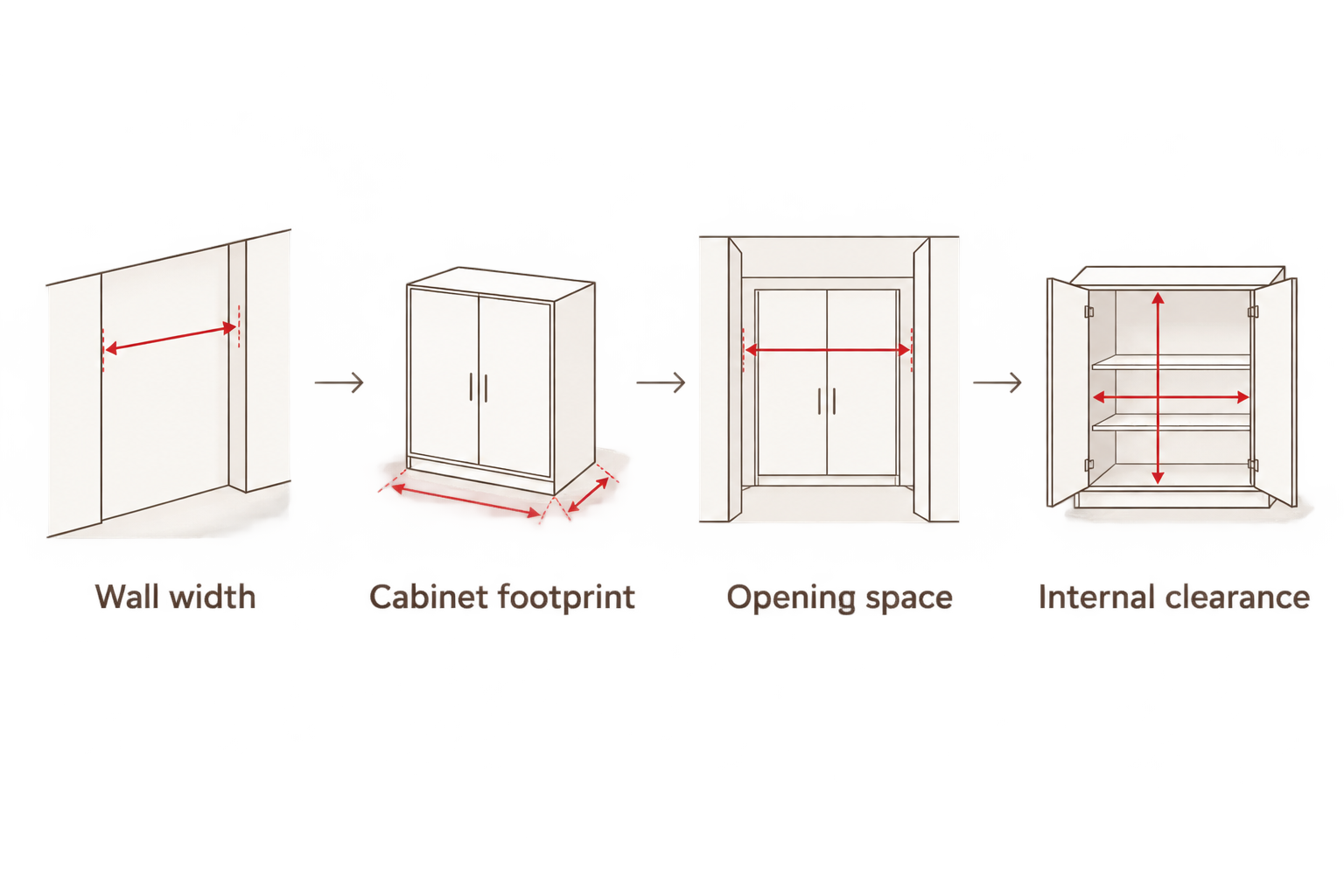
Measure the room before choosing a configuration
Use this sequence for your 2026 purchase. Record all measurements in one unit first, then convert only when necessary; 1 inch equals 2.54 cm.
Wall width
Measure the usable wall between actual obstructions, not just between corners. Include door trim, curtains, radiators, and furniture that will remain in place.
For a planning example, an 80 cm-wide cabinet on a 100 cm wall leaves 20 cm of total spare width. That is a layout calculation, not a product specification or a clearance recommendation.
Cabinet footprint
Mark the proposed width and depth on the floor with removable tape suited to your flooring. Walk past it carrying the things you normally carry through that space.
Check the baseboard projection and any plugs behind the cabinet. A nominal depth does not describe the full installed position when something prevents the back from approaching the wall.
Opening space
Mark the front's operating area as well as the cabinet body. Use the actual opening mechanism and dimensions supplied for the selected configuration.
A cabinet that fits while closed can still fail in daily use. Test the approach from the sofa, desk chair, or adjacent doorway before committing.
Internal clearance
Measure the objects first, especially files, equipment, and larger books. Compare them with usable compartment dimensions and the opening through which they must pass.
An object fitting inside a compartment does not prove that it will pass through the door opening. Check both.
What to verify in a modular steel alternative
The USM Haller dupe description identifies an alternative, not an assurance of identical engineering. For a 2026 comparison, separate the appearance of the frame from the documented properties of the system.
Ask for the information that changes your decision:
- Materials and finish: Identify the specified panel material, frame material, and finish rather than inferring them from photographs.
- Connections: Check how the ball-joint structure assembles and which tools the instructions require.
- Reconfiguration: Confirm which changes the selected system supports and which components those changes require.
- Loads: Check limits for shelves and the top separately, following the stated loading conditions.
- Compatibility: Require explicit confirmation before planning to combine parts from different systems.
Color comes after these checks. Arvhi offers 14 colors, but a color choice cannot correct insufficient depth or an obstructed door. Compare any finish information provided with the wall, flooring, and larger furniture already in your apartment.
Choose your modular steel furniture
Compare sideboards, cabinets, and shelving against your room measurements.
How the configurations are ranked
Compact closed storage ranks first because it addresses mixed household belongings without making display a requirement. Low, wide storage follows for rooms with available wall width; tall storage answers a width constraint; mixed storage serves a specific display brief.
This is a fit-based ranking, not a hands-on product test. Apply the same room-fit, access, storage, and system checks to the exact piece you are considering.
Which sideboard should you choose?
Choose a compact closed sideboard unless your room gives you a clear reason not to. Move to a low, wide configuration for a horizontal wall run, a tall cabinet for limited width, or mixed storage for a defined display collection.
For your 2026 shortlist, reject any configuration that fails the measurement check before comparing finishes. The best-looking front is irrelevant if you cannot open it properly.
FAQ
What’s the best USM Haller dupe sideboard for a small apartment?
A compact closed sideboard is the best default for mixed household storage. Choose the exact configuration by external dimensions, usable compartment space, and the clearance needed to open its fronts.
Is Arvhi original USM Haller furniture?
No. Arvhi offers USM Haller dupe furniture as an alternative and is not affiliated with USM.
Should I choose a low sideboard or a tall cabinet?
Choose a low sideboard when you have usable wall width; choose a tall cabinet when width is the constraint. Check upper-compartment reach and the manufacturer’s stability instructions before selecting a tall piece.
Is closed storage better than open shelving in a small living room?
Closed storage is better when your priority is concealing mixed belongings. Open compartments suit books and selected objects that you deliberately want on display.
Can I put a television on a modular steel sideboard?
Use a sideboard for a television only when its stated top-load limit and dimensions accommodate the television and stand. Check ventilation and cable access separately for any equipment stored inside.
Will parts from a USM Haller dupe fit original USM furniture?
Do not assume that parts fit across systems. Confirm the exact components and documented compatibility before buying furniture for a mixed-system arrangement.
What should I measure before buying a sideboard online in 2026?
Measure usable wall width, installed depth, opening space, and the belongings you need to store. Check those measurements against external dimensions, usable internal clearances, and the cabinet opening.
One last thing
Test the cabinet with its front open, not just with its footprint taped down. Recreate the operating space using a piece of cardboard, then sit down, walk past, and approach the storage as you normally would. That simple check exposes a layout conflict before it becomes a daily irritation.
Related guides