
Office Decor for Women: How to Build a Professional Home Office
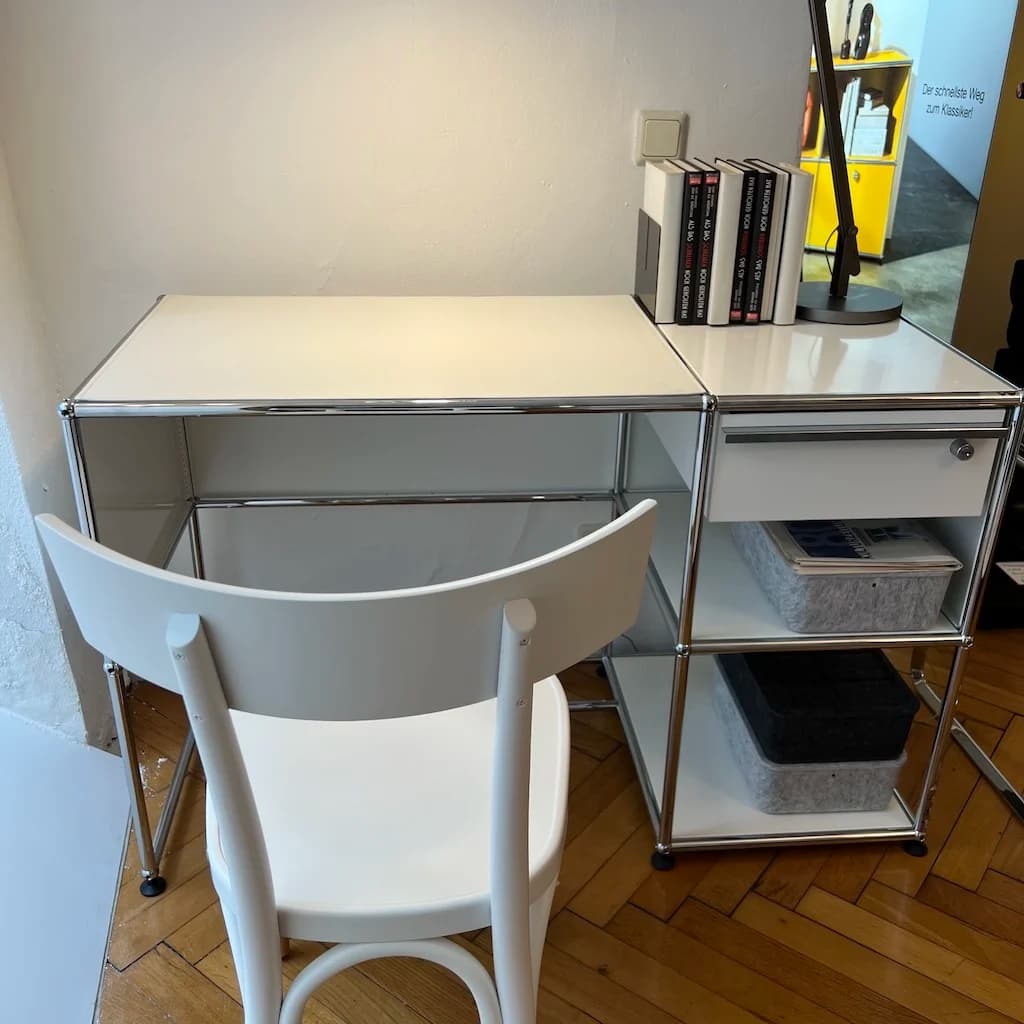
A professional home office for a woman comes down to four decisions: a desk and chair that fit your body, a palette of three colors, a backdrop that holds up on a video call, and closed storage for everything you do not want seen. The first is the one most decor guides skip. The average American woman is 63.5 inches (161 cm) tall, according to the CDC, and most fixed desks are built around a taller user, so fit is worth settling before you buy a single accessory.
Style is personal, and nothing below assumes you want pink, gold or florals. If you do, they work. If you would rather have black steel and walnut, that works too. What this guide covers is the part that makes any style read as professional: proportion, color discipline, lighting and the absence of clutter.
Start with fit: the desk height most guides skip
A desk that fits puts the keyboard at elbow height when you sit with your shoulders relaxed. OSHA lists 22 to 30 inches (55.9 to 76.2 cm) as the seated range for work surfaces, which is wide because people are. Our desk height by body height table turns that range into a number for your height:
| Your height | Seated work surface | A 75.2 cm desk sits |
|---|---|---|
| 5’0″ / 152 cm | 61.6 cm / 24.3 in | 13.6 cm / 5.4 in above it |
| 5’2″ / 157 cm | 63.6 cm / 25.0 in | 11.6 cm / 4.6 in above it |
| 5’4″ / 163 cm | 65.7 cm / 25.9 in | 9.5 cm / 3.7 in above it |
| 5’6″ / 168 cm | 67.7 cm / 26.7 in | 7.5 cm / 3.0 in above it |
| 5’8″ / 173 cm | 69.8 cm / 27.5 in | 5.4 cm / 2.1 in above it |
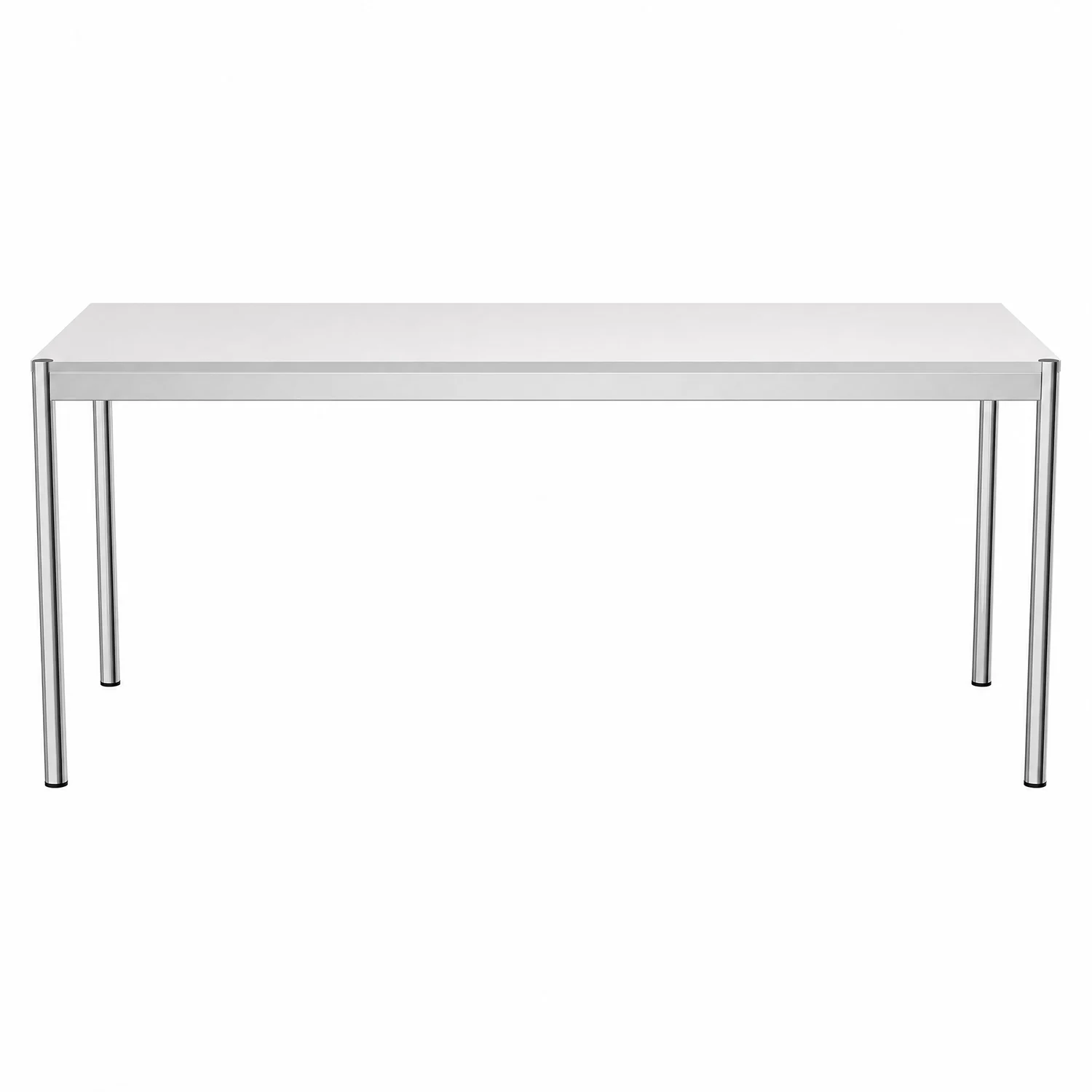
Our own Office Table is 75.2 cm (29.6 in) tall and our A1 Desk Unit is 76.2 cm (30 in). Both are fixed height. If you are 5’4″, either one sits roughly 10 cm above the surface height in the table, and we would rather you know that before ordering than after. There are three ways to close the gap:
- Raise the chair and add a footrest. The cheapest fix, and it keeps the desk you like. Raise the seat until your elbows meet the desk, then bring the floor up to your feet.
- Add a keyboard tray. OSHA lists 22 to 28.3 inches (55.9 to 71.8 cm) as the seated tray range, so a tray can bring the keyboard down without changing the desk.
- Choose a lower or adjustable desk. The right answer if you work long days at the keyboard and do not want a footrest.
Measure your own elbow height first: sit, bend your elbows to about 90 degrees, and measure from the floor to the underside of the elbow. That number beats any average, including the CDC’s. This section is a fit and dimensions guide, not medical or ergonomic advice.
Pick a palette of three colors
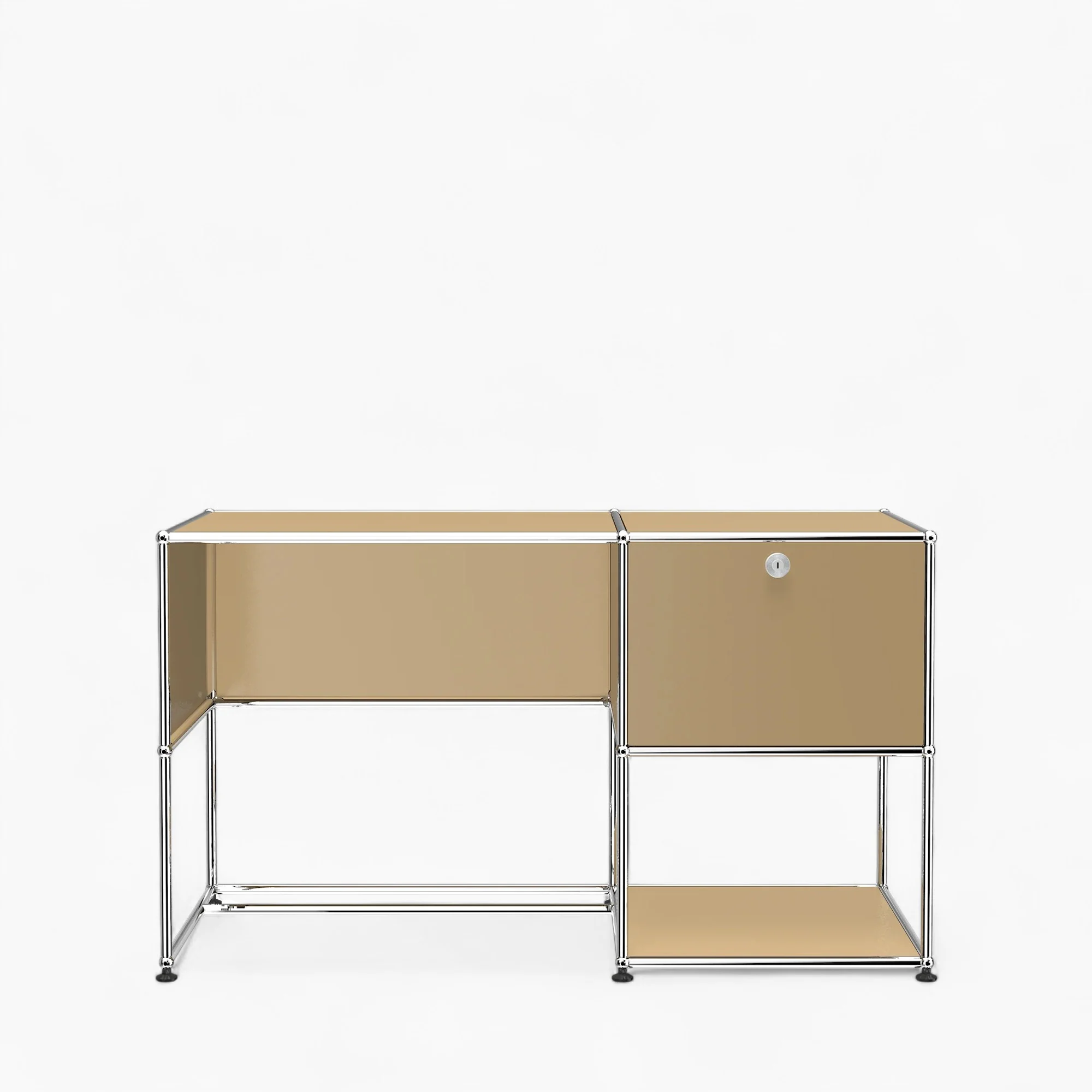
The office that looks expensive on camera usually has fewer colors, not better ones. Designers often use a 60/30/10 split as a rule of thumb: about 60 percent of what you see in one main color (walls, large furniture), 30 percent in a second (desk, shelving, rug) and 10 percent in an accent (art, a lamp, a chair, one colored panel). It is a guideline rather than a standard, but it stops a room from drifting into ten competing colors.
| Palette | 60 percent | 30 percent | 10 percent accent |
|---|---|---|---|
| Soft neutral | Warm white or cream walls | Beige or Light Gray steel, light oak | Brass lamp, linen, one framed print |
| Classic executive | Deep gray or navy walls | Graphite Black or Anthracite steel, walnut | Leather chair, a single Ruby Red element |
| Calm color | Off-white walls | Pure White steel, natural wood | Olive Green or Gentian Blue panels, plants |
| Bright and confident | Light Gray walls | Pure White or Light Gray steel | Golden Yellow or Pure Orange cabinet fronts |
The color names in the table are from our 14 standard powder-coat colors. Steel furniture makes the accent step easy: on a modular frame, the accent can be one cabinet door or one side panel rather than a whole piece, and panels can be swapped later if your taste moves on. Custom RAL colors are available on request through the configurator.
Design the part of the room your camera sees
If you take video calls, the wall behind your chair is the most visible surface in your home. Treat it as a deliberate backdrop rather than whatever happens to be there.
- Put the camera at eye level. A laptop flat on the desk films you from below and shows the ceiling. A stand or a stack of books fixes it.
- Face the light. A window in front of you or beside you lights your face. A window behind you turns you into a silhouette, however good the room looks.
- Frame one shelf, not a whole wall. A single open shelving unit behind the chair, styled with books, a plant and one object, reads as calm. A wall of open shelves reads as busy on a small screen.
- Keep labels and paper out of frame. Files, open documents, chargers and cables belong behind doors, not on the shelf the camera sees.
For the shelf itself, we use a simple ratio: fill about 60 to 70 percent of each shelf with books and leave the rest to a few objects and empty space. Our guide to office bookshelf decor works through it shelf by shelf, including how many books fit in each width.
Hide the clutter with closed storage
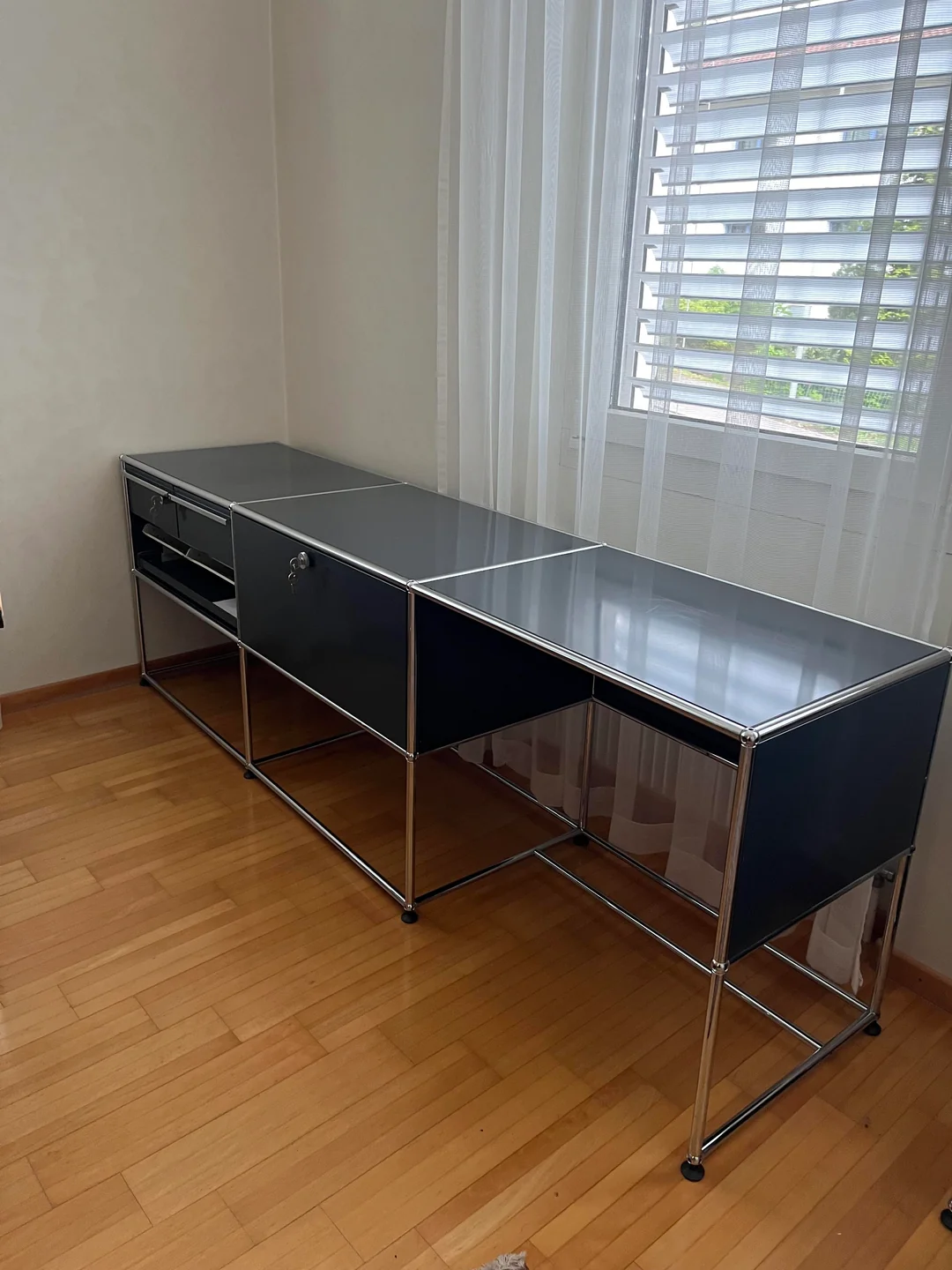
The single biggest difference between an office that looks professional and one that looks lived in is how much is visible. Paper, supplies, chargers and the printer are what make a room read as cluttered, and none of them need to be seen.
Plan storage in three zones:
- At arm’s reach, under or beside the desk: a rolling cabinet or drawer unit for what you use daily. Our M63 Rolling Cabinet moves out of the way when you need the legroom.
- Within the room, behind doors: a closed cabinet for archive files, printer paper and the things you use weekly. The M55 Cabinet works beside a desk; the taller M52 Cabinet takes a narrow wall.
- On display, in the open: the one shelving unit the camera sees, kept for books and a few chosen objects.
Run cables before you style anything. A cable tray under the desk and one power strip fixed to the underside of the top remove most of what you would otherwise see below a desk. On a steel frame desk the cables can follow the frame tubes down to the floor.
Light the room in three layers
One ceiling light is the reason most home offices look flat on camera. Three layers fix it:
- Ambient: the ceiling light or a floor lamp that lights the whole room.
- Task: a desk lamp aimed at your work surface, placed on the side opposite your writing hand so your hand does not shade the page.
- Accent: a small lamp on a shelf or a picture light, which gives the backdrop depth on camera.
Match the color of the bulbs. ENERGY STAR’s light bulb purchasing checklist describes 2700K to 3000K as warm or soft white, 3500K to 4100K as cool or neutral white and names it as good for work spaces, and 5000K to 6500K as daylight. Mixing a warm lamp with a daylight ceiling light makes walls look patchy on video. Pick one range for the whole room; for an office that is also used in the evening, a neutral 3500K is a sensible middle.
Accessories: fewer, larger, in odd numbers
Accessories are where a professional office tips into a cluttered one. Three habits keep them under control:
- Group in odd numbers. Decorators often cite a 3-5-7 rule: arrange objects in groups of three, five or seven, because odd groups look composed and even groups look lined up. On a desk, three objects is usually the limit.
- Choose fewer, larger pieces. One large framed print reads as intentional. Six small ones read as a pinboard.
- Keep the work surface for work. A lamp, one personal object and a tray for whatever is in use that day. Everything else goes in a drawer.
Plants, a rug that anchors the desk and a chair you actually like sitting in do more for a room than any desk accessory. If the chair is the piece you see most on camera, spend there.
The furniture backbone
Decor sits on top of a few large pieces. If you are furnishing from scratch, these are the ones that set the tone. Prices are our Fall Sale prices at the time of writing.
| Piece | Role in the room | Height | Price |
|---|---|---|---|
| Office Table | Main desk, open underneath | 75.2 cm / 29.6 in | $1,899 |
| A1 Desk Unit | Desk with built-in cabinet | 76.2 cm / 30 in | $1,499 |
| M63 Rolling Cabinet | Daily storage under the desk | See product page | $999 |
| M55 Cabinet | Closed storage beside the desk | 56.5 cm / 22.2 in | $799 |
| M56 Shelving | Low backdrop shelf | 99.1 cm / 39 in | $749 |
| R1 Shelving | Tall backdrop shelf | 179 cm / 70.5 in | $2,199 |
Every piece is built on the same chrome-plated steel frame with powder-coated panels in 14 standard colors, ships free with a 5-year warranty, and can be extended later. The full range is in the tables and desks collection, and the configurator prices a custom layout as you build it.
A checklist for a professional home office
- Desk height checked against your own elbow height, with a footrest or tray if the desk is fixed and too high
- A chair you can sit in for a full workday
- Three colors, split roughly 60/30/10
- Camera at eye level, facing the light
- One styled shelf in the camera’s frame, with closed storage for everything else
- Cables routed under the desk
- Three layers of light, all bulbs in one color range
- No more than three objects on the work surface
Frequently asked questions
How do I make my home office look professional?
Limit the room to three colors, keep paper and cables behind closed doors, and style one shelf as the backdrop for video calls. Put the camera at eye level and face the light. A room with less on show reads as more professional than one with more decor.
What is the 3-5-7 rule in decorating?
It is a rule of thumb, not a standard: group decorative objects in odd numbers, usually three, five or seven, because odd groups look composed while even groups look lined up. On a desk or a single shelf, a group of three is usually enough.
What desk height suits a 5’4″ woman?
About 65.7 cm (25.9 in) for a seated work surface, based on the proportion in our desk height by body height table. Your own elbow height, measured seated with your elbows at about 90 degrees, is more accurate than any average. A standard 75 cm desk sits roughly 10 cm higher, so plan for a footrest or a keyboard tray.
What colors look professional in a home office?
Any palette looks professional when it is limited. A common approach is one main color for walls, a second for the large furniture and one accent used sparingly: for example warm white walls, beige steel and oak, and a brass lamp as the accent.
What are the must-haves for a work from home office?
A desk at the right height, a chair you can sit in all day, closed storage for paper and supplies, a task lamp, and a camera position at eye level facing the light. Decor comes after those five.
Sources
- CDC, National Center for Health Statistics, FastStats: Body Measurements (average height of US women aged 20 and older: 63.5 inches). cdc.gov
- OSHA, Computer Workstations eTool, Workstation Components: Desks. osha.gov
- OSHA, Computer Workstations eTool, Checklists: Purchasing Guide (seated work surface and keyboard tray ranges). osha.gov
- ENERGY STAR, Light Bulb Purchasing Checklist (color temperature ranges and their uses).
Arvhi sells the desks, cabinets and shelving listed in this guide. The desk height section explains dimensions and fit; it is not medical or ergonomic advice, and the OSHA eTool ranges are advisory guidance rather than requirements. Arvhi products are not manufactured by or affiliated with the original designer(s) and associated parties, and we do not claim any rights on any third party trademarks.