
Office Bookshelf Decor: How to Style a Shelf You Actually Work From
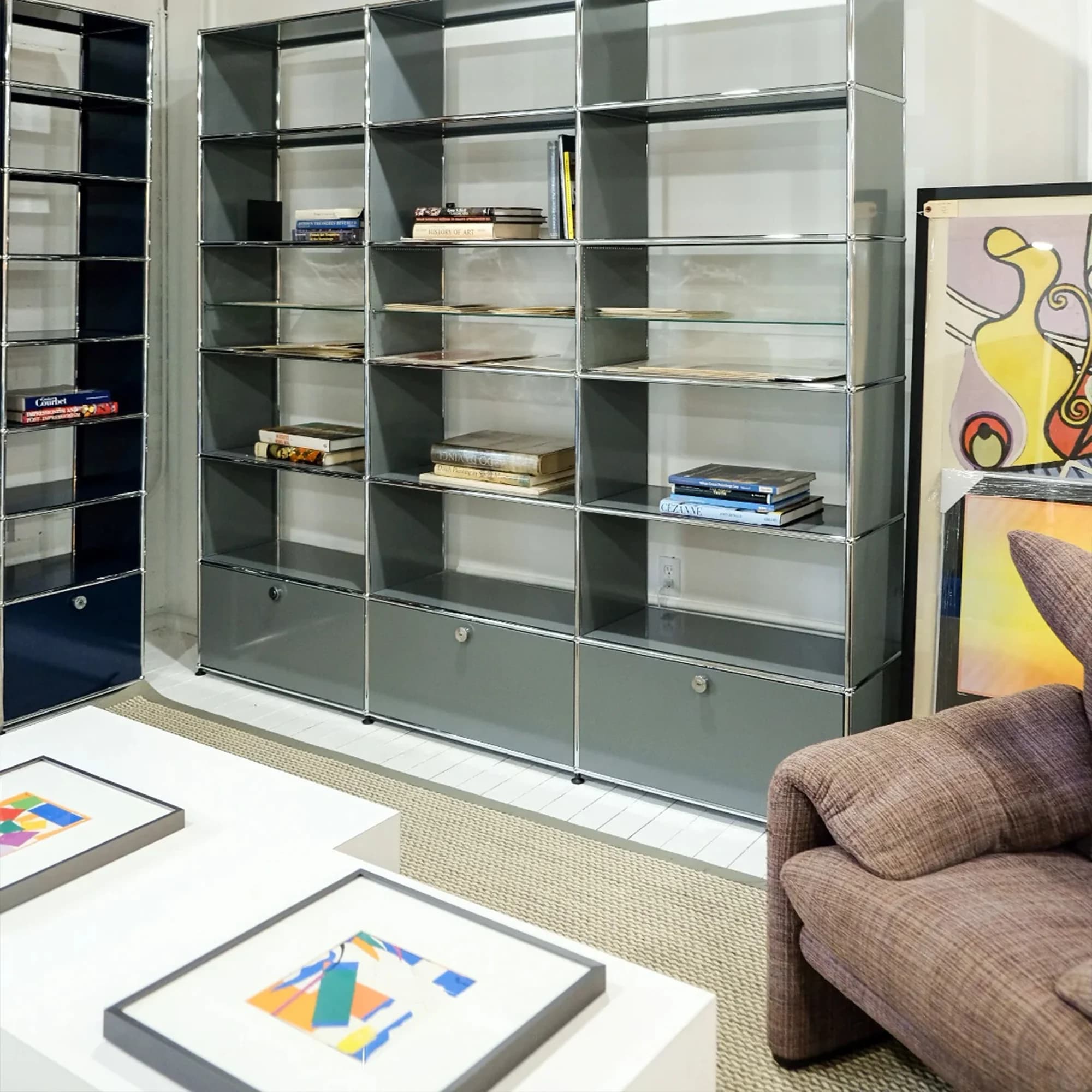
To style an office bookshelf, decide what the shelf has to do for your work first, then fill about 60 to 70 percent of each shelf with books and give the rest to a few objects and empty space. On a 750 mm (29.5 in) shelf, that works out to roughly 12 to 14 books instead of the 20 it can physically hold. The empty space is what makes a working shelf look styled rather than stored.
This guide gives you the numbers behind that: how many books each shelf width holds, which book sizes fit which compartment, and a five step method for arranging a shelf you actually use during the workday.
What an office bookshelf has to do
A bookshelf in a living room is mostly for display. A bookshelf in an office has three jobs, and styling works best when you plan for all three before you place a single object.
- Reference. The books, binders and manuals you open during the week. These need to be reachable without moving anything else.
- Storage. Paper, supplies, chargers and archive boxes. These are the items that make a shelf look cluttered, so they belong behind doors or in boxes.
- Backdrop. If the shelf sits behind your desk, it is in every video call. That shelf is seen more often than any other furniture in the house.
Most styling advice only covers the third job. The result is a shelf that photographs well and fails the first week you need a book from it.
How many books fit on a shelf
Borroughs, a manufacturer of library bookstacks, plans shelf capacity at eight volumes per foot of shelf in its bookstack planning guide. Applied to the three common modular shelf widths, it gives you a full shelf and a styled shelf:
| Shelf width | Full shelf (8 per foot) | Styled shelf (60 to 70 percent books) |
|---|---|---|
| 350 mm / 13.8 in | about 9 books | 5 to 6 books |
| 500 mm / 19.7 in | about 13 books | 8 to 9 books |
| 750 mm / 29.5 in | about 20 books | 12 to 14 books |
The 60 to 70 percent split is a designer rule of thumb rather than a standard, and you will see it quoted as 60/40, two thirds, or 70/30. The exact ratio matters less than the habit: count your books before you buy shelving, then add about 40 percent more shelf length than the books need. That extra length is where the objects and the empty space go.
Library figures assume general books. Thick hardcovers, binders and art books take more room per foot, so treat the table as a ceiling for those.
Which books fit which compartment
Before styling, check that your books physically fit. Two numbers decide it: the compartment depth has to be at least the width of the book’s cover, and the compartment height has to clear the book’s height with room for your fingers.
Amazon’s self publishing service lists the trim sizes most US books are printed in. KDP names 6 x 9 inches as the most common, and its cover calculator caps paperbacks at 8.5 x 11.69 inches.
| Book size | Cover width (needs this depth) | Book height | 250 mm compartment | 350 mm compartment |
|---|---|---|---|---|
| 5 x 8 in | 12.7 cm | 20.3 cm | Fits | Fits |
| 5.5 x 8.5 in | 14.0 cm | 21.6 cm | Fits | Fits |
| 6 x 9 in (most common) | 15.2 cm | 22.9 cm | Fits, about 2 cm spare | Fits |
| 8.5 x 11.69 in (KDP maximum) | 21.6 cm | 29.7 cm | Too short | Fits |
Three practical rules follow from the table:
- A 175 mm compartment is too low for any of these sizes standing upright. Use it for boxes, small objects, or books laid flat.
- A 250 mm compartment takes most novels and nonfiction, but large format and coffee table books need 350 mm.
- Depth is rarely the problem. A 350 mm deep shelf holds every size in the table with room behind, which is where the next section’s trick comes from.
On a modular unit, compartment heights are set by the length of the vertical tubes, and the module sizes are nominal. Measure the inner height of your own compartment before deciding where the tall books go.
How to style an office bookshelf in five steps
1. Empty it and sort into three piles
Take everything off. Sort into work items you use weekly, things you want on display, and things that need storing but not seeing. Anything that fits none of the three leaves the office.
2. Give the working shelves the best height
Put the weekly work items on the shelves you can reach while standing in front of the unit without bending or stretching. Archive boxes go on the lowest shelf, rarely used books on the highest. On a shelf behind a desk, the working shelves are usually the middle two.
3. Mix vertical rows with a few horizontal stacks
Stand most books upright in groups, and lay a few in short stacks of three to five. A horizontal stack doubles as a riser for a small object. Grouping books by color or by size makes a shelf read as calmer than grouping by topic, but only do that on display shelves. On working shelves, group by how you look things up.

4. Add objects in small groups
Use one to three objects per shelf, not one per gap. Vary the height inside each group: a tall vase next to a low bowl reads better than two items of the same size. Repeat a material or color on two or three shelves so the unit looks planned as a whole.
5. Leave a third of each shelf empty
This is the step most shelves skip. Empty space separates the groups so each one can be seen. If a shelf looks full after step four, remove an object rather than adding another.

Where office clutter goes
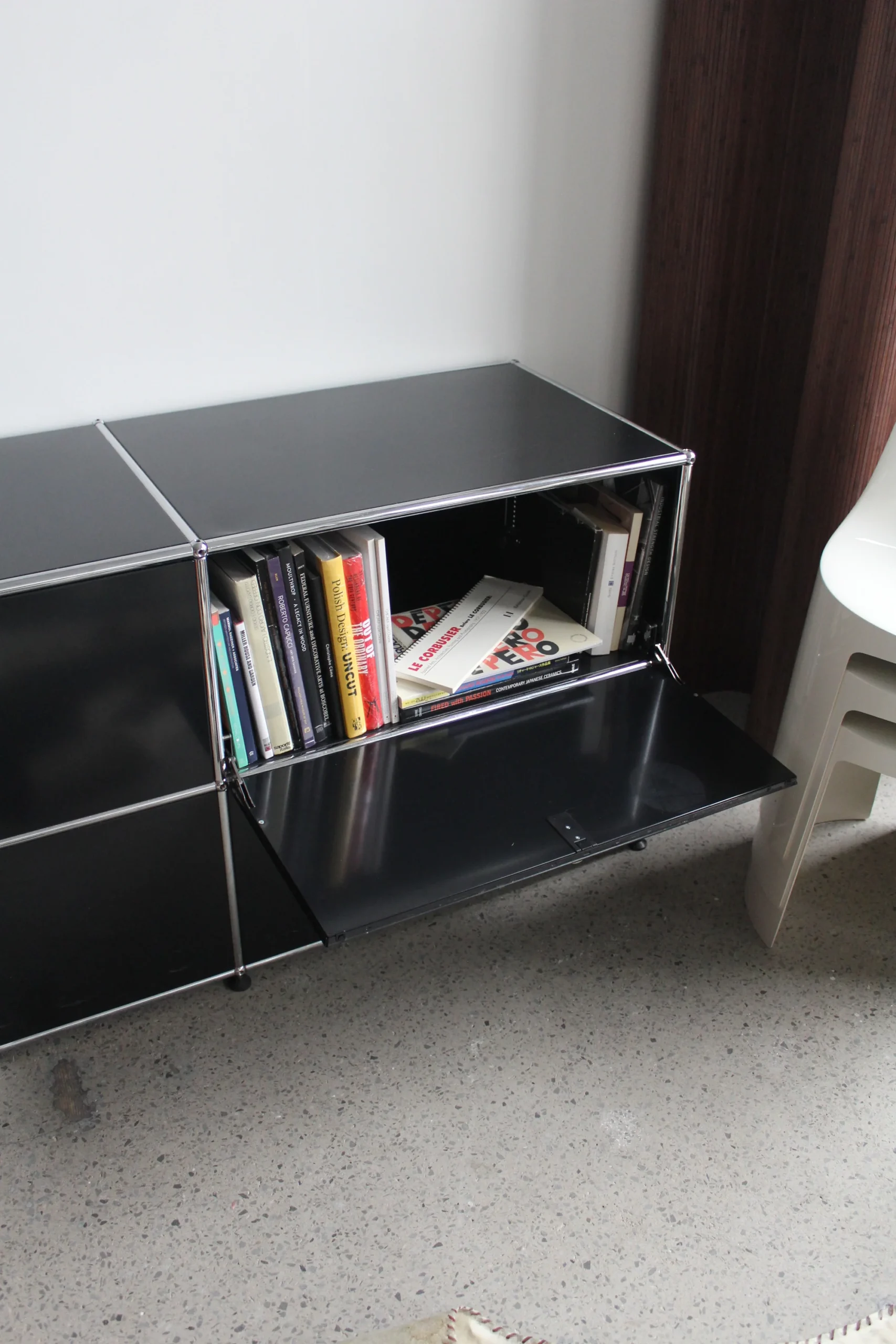
Binders, file boxes and supplies are taller and less attractive than books, and they are the main reason office shelves look busy. On a shelf with only open compartments, put them in matching boxes on the bottom shelf. On a modular unit, give them a closed compartment instead: a door or a drop front hides the supplies and keeps the open compartments for books and objects.
Use the depth too. A 350 mm shelf holding a 15 cm deep book has about 20 cm of space behind it. Chargers, cables and a power strip can sit there, out of sight of the camera.
Styling the shelf behind your desk for video calls
If the shelf is behind you, check it through your own camera before you finish. The camera crops the unit, so only one or two shelves will usually be in frame, and those are the ones to style most carefully.
- Keep anything with readable text facing away or out of frame: book spines are fine, open documents and labeled files are not.
- Place a single larger object, a plant or a lamp, slightly off center from your head so it does not appear to grow out of it.
- Avoid filling the visible shelf. On camera, a mostly empty shelf with one group looks deliberate, while a full shelf looks busy behind you.
Arvhi shelving measurements
Arvhi shelving is built from chrome plated steel tubes, stainless steel ball joints and powder coated steel panels, in 14 standard colors. Each shelf is rated for up to 50 kg; our guide to modular steel shelf load capacity explains what that rating covers. Units can be expanded later with extra modules from the spare parts catalog, which lists shelves in 350, 500 and 750 mm widths.
| Model | Height | Width | Depth | Weight |
|---|---|---|---|---|
| M56 Shelving | 99.1 cm / 39 in | 77.5 cm / 30.5 in | 38.1 cm / 15 in | 25.9 kg |
| R1 Shelving | 179.0 cm / 70.5 in | 77.3 cm / 30.4 in | 37.3 cm / 14.7 in | 67.6 kg |
| H27 Shelving | 159.0 cm / 62.6 in | 150.0 cm / 59.1 in | 35.0 cm / 13.8 in | 73.5 kg |
| H2 Shelving | 180.3 cm / 71 in | 152.4 cm / 60 in | 38.1 cm / 15 in | 87.2 kg |
| C18 Shelving | 179.0 cm / 70.5 in | 228.0 cm / 89.8 in | 38.1 cm / 15 in | 137.0 kg |
For an office, the narrow units (M56, R1) fit beside a desk, and the wide units (H2, C18) work as a wall behind it. All of them are in the shelving and storage collection, and the configurator lets you set your own mix of open and closed compartments. For how modular systems compare in general, see our modular shelving systems guide.
Frequently asked questions
How do you decorate an office bookshelf?
Plan for work first: put the books and binders you use weekly on the shelves you can reach easily, and hide supplies in boxes or closed compartments. Then fill about 60 to 70 percent of each display shelf with books, add one to three objects per shelf, and leave the rest empty.
How many books should go on a shelf?
Library shelving planning guides use about eight books per foot of shelf at full capacity. For a styled shelf, use 60 to 70 percent of that: roughly 5 to 6 books on a 350 mm shelf, 8 to 9 on a 500 mm shelf and 12 to 14 on a 750 mm shelf.
How deep should a bookshelf be for books?
At least as deep as the widest book cover you own. The most common US book size, 6 x 9 inches, needs about 15.2 cm, and the largest standard paperback, 8.5 x 11.69 inches, needs about 21.6 cm. A 350 mm deep shelf holds all of them with space behind.
Should books be vertical or horizontal on a shelf?
Mostly vertical, with a few short horizontal stacks of three to five books. The stacks break up long rows and can hold a small object on top. Books too tall for the compartment should always lie flat.
What should not go on an office bookshelf?
Anything you would not want seen on a video call, such as open documents, labeled files and loose cables, plus supplies that are better kept in boxes or behind a door. Keep the open shelves for books and a few chosen objects.
Sources
- Borroughs, Wilsonstak Bookstack Planning and Layout Guide (capacity at eight volumes per shelf foot).
- Amazon KDP, Print Options: trim sizes (6 x 9 inches named as the most common US size). kdp.amazon.com
- Amazon KDP, Print Cover Calculator and Templates: trim limits up to 8.5 x 11.69 inches. kdp.amazon.com
Arvhi sells the shelving units listed in this guide. Photos credited to Unsplash show other furniture and are used to illustrate styling only. Arvhi products are not manufactured by or affiliated with the original designer(s) and associated parties, and we do not claim any rights on any third party trademarks.