
Desk Height by Body Height: The Table (and the 10-Second Elbow Test)
Your desk should put your keyboard at elbow height when you sit with your shoulders relaxed. For most adults that lands between 55.9 cm and 76.2 cm (22 to 30 inches), the seated range OSHA lists for work surfaces. The number that matters is your own elbow height, and finding it takes about ten seconds.
If you would rather skip the method: sit down, bend your elbows to roughly 90 degrees with your forearms level, then measure from the floor to the underside of your elbow. That measurement is your work surface height. Everything below exists for the times you cannot measure, such as buying for someone else, checking a desk you already own, or working out whether a fixed height will fit you before you order.
How to measure your own desk height in three steps
- Sit with your feet flat on the floor, your back against the chair back, and your shoulders down.
- Let your elbows hang at your sides, then bend them to about 90 degrees so your forearms are level with the floor.
- Measure from the floor to the underside of your elbow. Write the number down in centimetres and in inches.
Two details change the result and are worth getting right. Wear the shoes you actually work in, because a 2 cm sole moves the number by 2 cm. And if you use a keyboard tray rather than the desktop, measure to the tray, since the tray is the surface your hands sit on.
This is a measurement, not a posture routine. It tells you which surfaces fit your body, in the same way a shoe width tells you which shoe fits your foot.
Desk height by body height
The table below converts body height into two practical numbers: the work surface height for seated work, and the keyboard height for standing work. It uses the proportions 0.404 and 0.61 of body height, the ratios used by most desk height calculators.
| Your height | Seated work surface | Standing keyboard height |
|---|---|---|
| 5’0″ / 152 cm | 61.6 cm / 24.3 in | 93.0 cm / 36.6 in |
| 5’2″ / 157 cm | 63.6 cm / 25.0 in | 96.1 cm / 37.8 in |
| 5’4″ / 163 cm | 65.7 cm / 25.9 in | 99.2 cm / 39.1 in |
| 5’6″ / 168 cm | 67.7 cm / 26.7 in | 102.3 cm / 40.3 in |
| 5’8″ / 173 cm | 69.8 cm / 27.5 in | 105.4 cm / 41.5 in |
| 5’10” / 178 cm | 71.8 cm / 28.3 in | 108.5 cm / 42.7 in |
| 6’0″ / 183 cm | 73.9 cm / 29.1 in | 111.6 cm / 43.9 in |
| 6’2″ / 188 cm | 75.9 cm / 29.9 in | 114.7 cm / 45.2 in |
| 6’4″ / 193 cm | 78.0 cm / 30.7 in | 117.8 cm / 46.4 in |
If you want every model dimension in one place, our dimensions and configuration guide lists them. Treat these as starting values, not answers. Two people of the same total height can differ by several centimetres in torso and arm length, so the column can be off by 2 to 3 cm in either direction. The elbow measurement is the accurate version of the same number.
What the standards actually specify
The numbers most often cited come from the US Occupational Safety and Health Administration, which publishes a free guidance document called the Computer Workstations eTool. It is guidance rather than a legal requirement, and it is useful here because the values are specific.
“Keyboard height should be adjustable between 22 inches and 30 inches for seated tasks and 36 to 46.5 inches for standing tasks. The keyboard height should be at about elbow height.”
OSHA, Computer Workstations eTool, Purchasing Guide
| Measurement | Inches | Centimetres |
|---|---|---|
| Keyboard height, seated | 22 to 30 | 55.9 to 76.2 |
| Keyboard height, standing | 36 to 46.5 | 91.4 to 118.1 |
| Keyboard tray range, seated | 22 to 28.3 | 55.9 to 71.8 |
| Monitor distance from eyes | at least 20 | at least 50.8 |
| Clearance under the desk | 20 to 28 | 50.8 to 71.1 |
| Desktop thickness, preferred | no more than 2 | no more than 5.1 |
Notice what the ranges are for: they cover the adult population between roughly the 5th and 95th percentile, which is why they are wide. A single fixed desk cannot sit inside every person’s slice of that range, and that is the whole reason the range exists.
Standing desk height
For standing work, the same rule applies with a different reference point: the keyboard goes at your elbow height while you stand. In practice that is 30 to 40 cm above your seated desk height, because the proportion moves from 0.404 to 0.61 of body height.
Add your shoe sole to the figure. A 2 cm sole raises your elbows by 2 cm, which is why two people with the same body height can need different desks.
Floor desk height
People search for this in two different situations: a low table used while sitting on the floor, and a desk with no legs at all. Neither has an OSHA figure, because the published ranges assume a chair. So there is no honest standard number to quote here.
What does transfer is the method. Sit on the floor the way you will actually sit, cross legged or kneeling, then measure from the floor to the underside of your elbow with your forearms level. That number is the height of the table top you want. Expect it to be far lower than a standing desk, and expect your sitting position to decide more of it than your height does. If you plan to change positions during the day, measure both of them and choose the higher one, then add a cushion for the lower position.
If you are 5’4″ or shorter
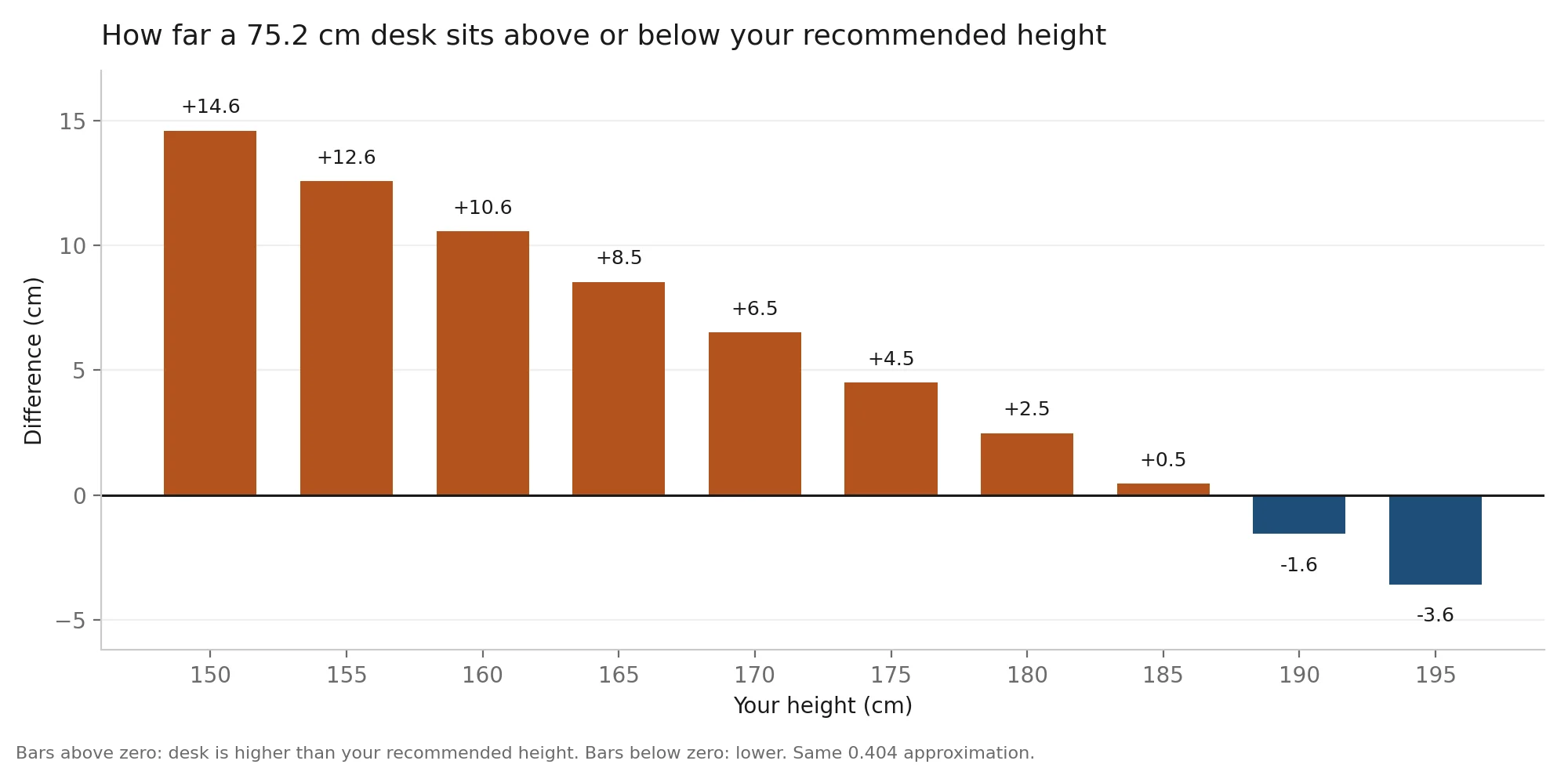
A standard 75 cm desk is above the recommendation for anyone under roughly 186 cm. At 163 cm, the recommendation works out to 65.7 cm, which is 9.5 cm below that desk surface. This is normal for fixed height furniture, and there are three workable answers.
- Raise the chair and add a footrest. This is OSHA’s own suggestion when a work surface cannot be lowered. Your knees stay at the right height, your feet stop dangling, and your elbows reach the desktop.
- Use a keyboard tray. The tray brings the keyboard down into the 55.9 to 71.8 cm range without changing the desk.
- Choose a lower or adjustable desk. If you are buying new, this is the cleanest route, because it removes the compromise rather than compensating for it.
If you are 6’2″ or taller
The same arithmetic runs the other way. At 193 cm the recommendation is 78.0 cm, so a 75.2 cm desk sits about 2.8 cm low, and a 76.2 cm desk is closer but still slightly under. For a fixed desk, the practical fixes are risers under the legs, which OSHA mentions, or a keyboard tray set above the desktop rather than below it.
What Arvhi desks measure
Our two desk models are fixed height, so the numbers matter more than they would on an adjustable desk. Both sit in the tables and desks collection, and if you are furnishing a whole workspace, the home office collection uses the same frame system. Both are built on the same chrome plated steel frame and powder coated panels as the rest of the system, and both ship flat packed.
| Model | Height | Width | Depth | Weight | Fits about |
|---|---|---|---|---|---|
| Haller Office Table | 75.2 cm / 29.6 in | 175.0 cm / 68.9 in | 75.2 cm / 29.6 in | 42.0 kg | 186 cm / 6’1″ |
| Haller A1 Desk Unit | 76.2 cm / 30 in | 127.0 cm / 50 in | 50.8 cm / 20 in | 31.9 kg | 189 cm / 6’2″ |
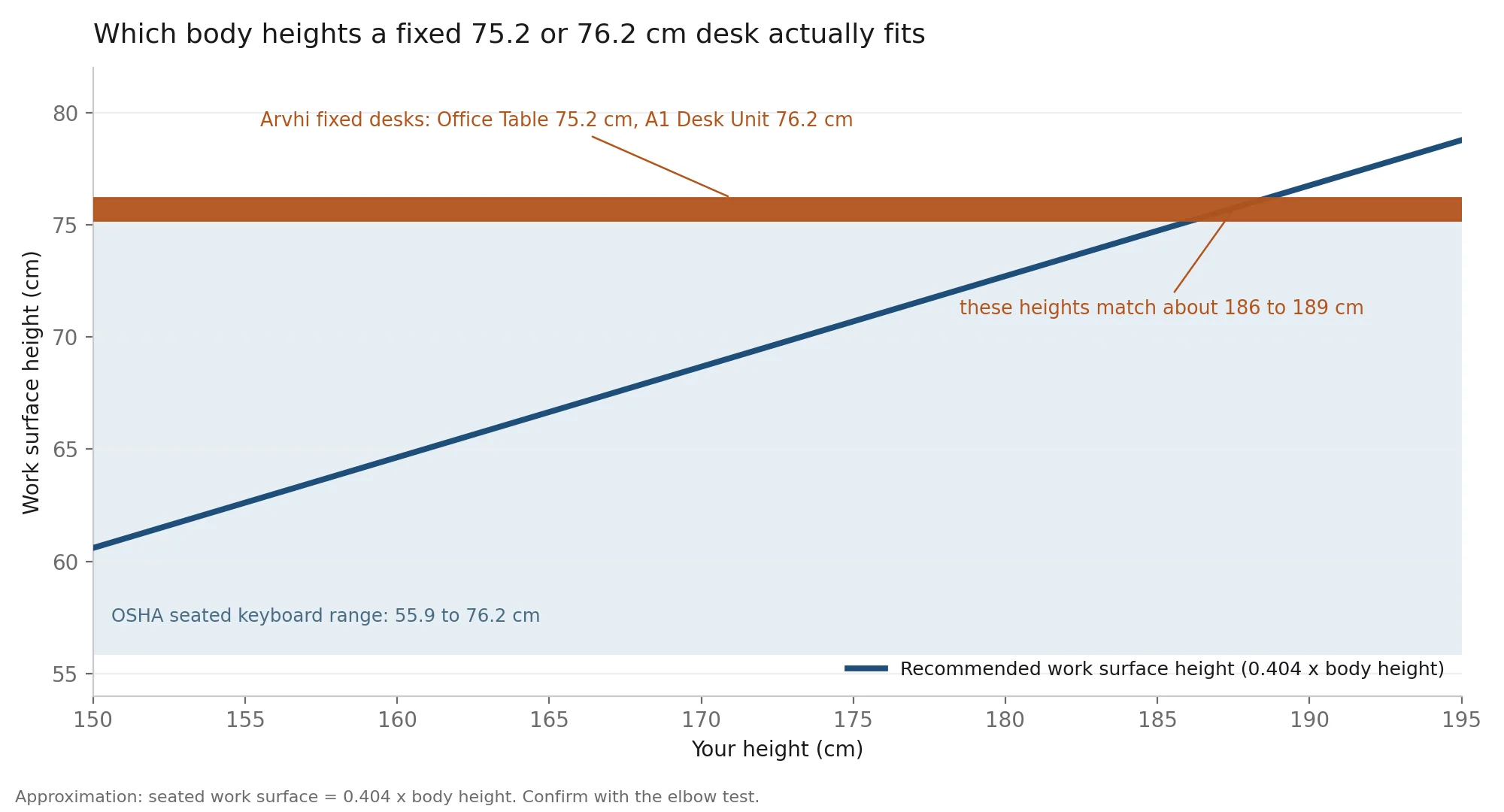
Stated plainly: if you are around 6’1″, either desk lands on your measurement. If you are 5’4″, it will be about 9.5 cm above it, and you will want a footrest, a keyboard tray, or a different height. We would rather you know that before ordering than after.
Frequently asked questions
Is a 75 cm desk too high?
It depends on your height. 75 cm matches a body height of about 186 cm on the proportion above. If you are shorter, expect the surface to sit above your elbow height and plan for a footrest, a keyboard tray, or a lower desk.
What is the correct desk height for typing?
Elbow height while seated, with your shoulders relaxed and your forearms level. OSHA gives 55.9 cm to 76.2 cm (22 to 30 inches) as the adjustable range for seated keyboard work, which is wide by design because it covers most of the adult population.
What height should a standing desk be?
Your elbow height while standing, with your shoes on. For most adults that is between 91.4 cm and 118.1 cm (36 to 46.5 inches). It is roughly 30 to 40 cm above the same person’s seated desk height.
What is floor desk height?
There is no standard figure, because the published ranges assume a chair. Measure from the floor to the underside of your elbow while sitting on the floor in the position you will use, and treat that as your table top height.
Do I need a keyboard tray?
Only if the surface you have cannot reach your elbow height. Trays adjust through roughly 55.9 cm to 71.8 cm (22 to 28.3 inches), so they solve a desk that is too high. They do not solve a desk that is too low.
Sources
- OSHA, Computer Workstations eTool, Workstation Components: Desks. osha.gov
- OSHA, Computer Workstations eTool, Workstation Components: Keyboards. osha.gov
- OSHA, Computer Workstations eTool, Checklists: Purchasing Guide. osha.gov
Arvhi sells the desks listed in this guide. This page explains dimensions and fit; it is not medical or ergonomic advice. If you are choosing a desk for a specific need, measure your own elbow height first, and check the full dimensions of any model you are considering on its product page.