
Modular Shelving Systems: How They Work and What to Check Before You Buy
A modular shelving system is storage built from repeating parts on a shared frame, so you can change the layout later instead of replacing the unit. The parts matter more than the look: the connector determines how much weight each shelf holds and whether the system can be taken apart and rebuilt without damage. This guide covers how the connections work, what load ratings actually mean, and when a fixed cabinet is the smarter purchase.

What Is a Modular Shelving System?
A modular shelving system is made of standard components that repeat: vertical supports, horizontal shelves, connectors, and optional panels, doors, or drawers. Every part follows the same dimensional grid, so components can be added, removed, or rearranged.
That is the practical difference from a bookcase. A bookcase is one finished object. A modular system is a kit that stays a kit, even after assembly. Shelving is one category within modular furniture more broadly, and the one where reconfiguration delivers the most.
The distinction matters when your needs change. A modular unit that starts as a two by three shelf in a living room can become a wider credenza, gain doors, or split into two smaller units in different rooms. A bookcase can only be moved or replaced.
How Do the Parts Actually Connect?
This is the part most product pages skip, and it is the part that decides whether a system lasts.
There are three common connection methods:
| Connection type | How it works | Trade-off |
|---|---|---|
| Cam lock and dowel | A metal cam rotates to grip a pin, the standard flat-pack fitting | Cheap and light, but the particleboard around the cam wears with repeated assembly. Most flat-pack furniture is rated for limited rebuilds. |
| Bracket and upright | Shelves rest on brackets clipped into slotted vertical rails | Easy height adjustment, but the load path runs through a small clip and the system usually needs wall anchoring. |
| Ball joint | A spherical connector joins tubes in multiple directions at once, forming a rigid three dimensional frame | More expensive to manufacture, but the frame carries load in every direction and can be dismantled and rebuilt repeatedly. |
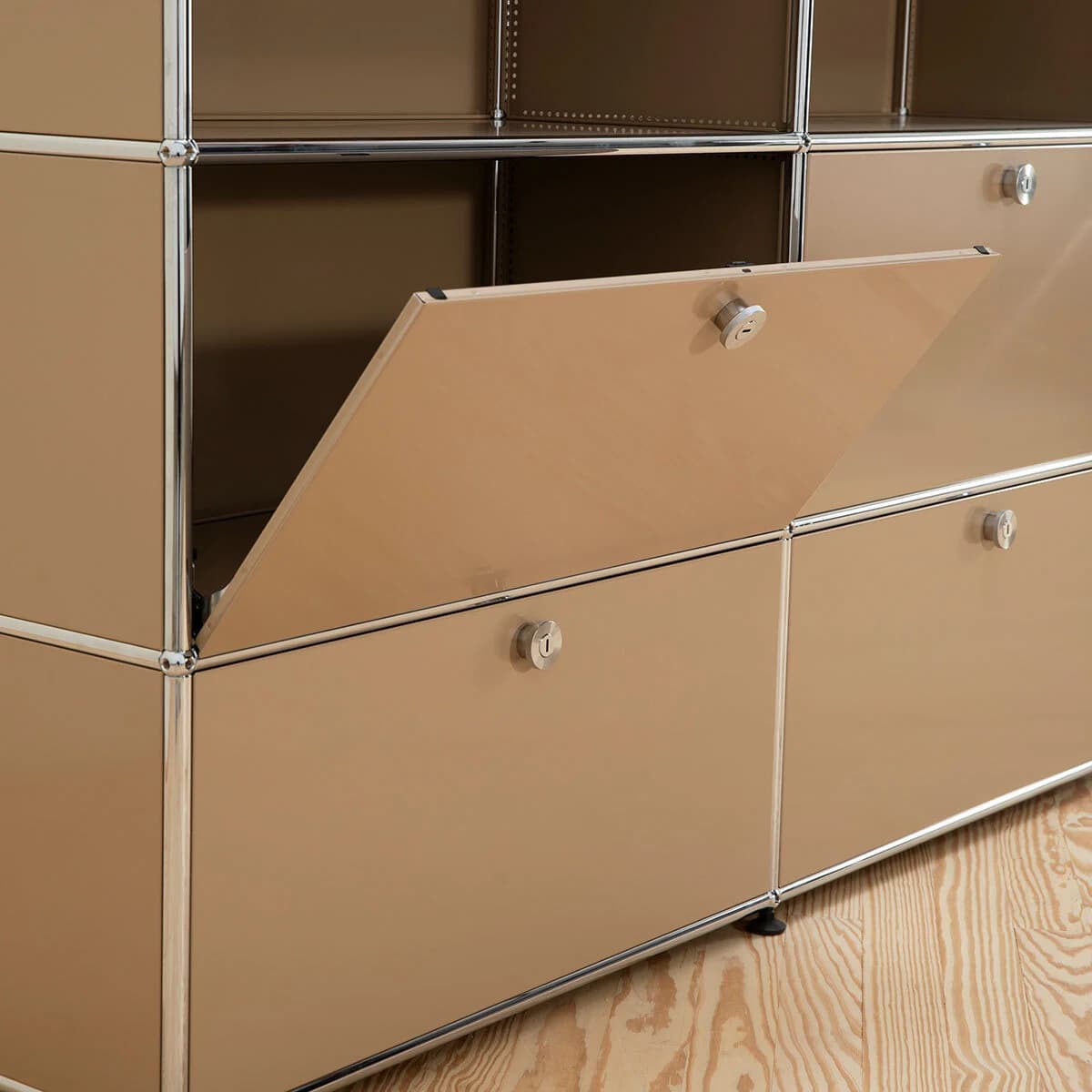
Arvhi uses stainless steel ball joints. Each joint accepts connections along several axes at once, which is what allows a flat shelf like the R1 Shelving, a tall unit like the H27 Shelving, and a deep sideboard like the E2 Sideboard to be built from the same parts inventory.
The reason ball joints suit reconfiguration is mechanical rather than stylistic. The joint grips the tube rather than biting into a board, so taking the frame apart does not remove material. Nothing is drilled out, and nothing is stripped. That is why a ball joint system can be rebuilt in a new shape years later and still be as rigid as it was on day one.
How Much Weight Can Modular Shelving Hold?
Arvhi shelves are rated to 50 kg (about 110 lb) each, spread evenly across the span. Two details decide whether any published rating means what you think it does: whether it is per shelf or per unit, and whether your load is distributed or concentrated in one spot. Both are covered in the shelf load capacity guide.
Modular Shelving vs Fixed Shelving: Which Should You Buy?
| Modular system | Fixed bookcase or cabinet | |
|---|---|---|
| Upfront cost | Higher | Lower |
| Cost to change layout | Buy additional components | Buy a new unit |
| Survives moving house | Designed for it | Often does not |
| Load capacity | Usually higher, load runs through a metal frame | Varies, often limited by board thickness |
| Assembly time | Longer on first build | Shorter |
| Repairability | Individual parts replaceable | Usually whole unit replacement |
| Best for | Changing needs, renting, growing collections | A known need in a fixed space |
The honest summary: modular costs more at the start and pays back only if the layout actually changes. If you know the space and the contents will stay the same for a decade, a well built fixed cabinet is the better value.
What Can You Reconfigure, and What Can’t You?
Marketing language around modular furniture tends to imply unlimited freedom. The reality is narrower and worth understanding before you buy.
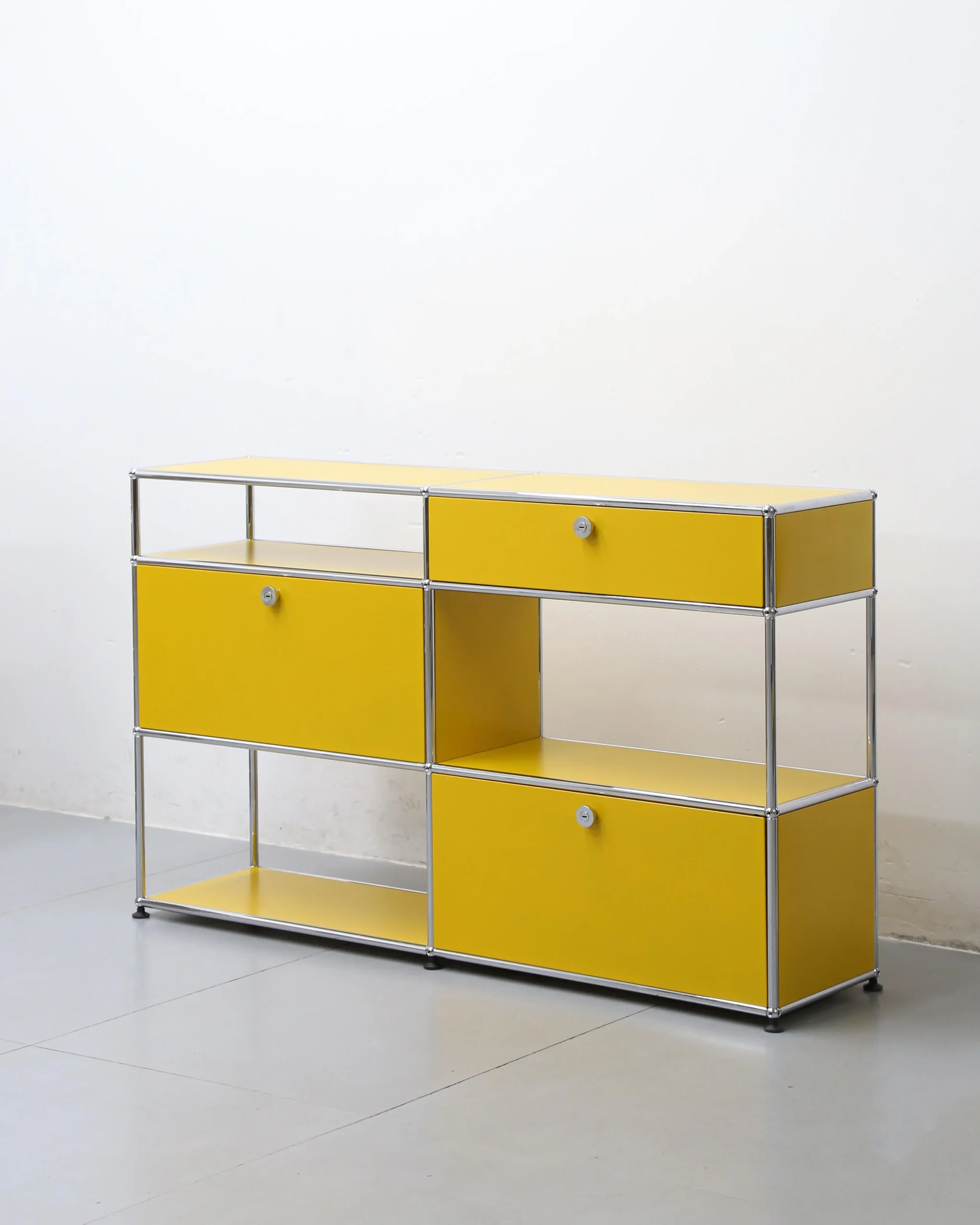
What genuinely changes:– Height, by adding or removing tiers- Width, by adding bays- Open shelving converted to closed storage with doors or drawers- Splitting one unit into two, or merging two into one- Adding castors to make a static unit mobile
What does not change:– The grid itself. Module dimensions are fixed, so shelf spans come in setincrements rather than any measurement you choose.- Depth, in most cases, since depth is set by the frame components you bought.- Colour, unless you buy replacement panels.
That grid constraint is the real trade-off. You gain the ability to rearrange, and you give up the ability to hit an exact custom dimension. For an alcove that needs to be filled precisely to the millimetre, built in joinery still wins.
Which Materials Should You Look For?
| Component | Arvhi specification | Why it matters |
|---|---|---|
| Frame | Chrome plated steel | Carries load without sagging over long spans |
| Connectors | Stainless steel ball joints | Corrosion resistant, survives repeated assembly |
| Panels | Powder coated metal, scratch resistant | Does not swell or delaminate the way particleboard does |
| Finish | Matte or gloss | Fingerprint resistant and wipeable |
| Colour | RAL range | Replacement parts still match years later |
The colour point is underrated. Systems designed to be extended need colours that remain available. A discontinued finish turns a modular system into a fixed one, because any part you add later will not match.
Who Should Not Buy a Modular Shelving System
Four situations where something else is the better answer:
You need to fill an exact alcove. Grid increments will leave a gap. Built in joinery or a made to measure unit solves this properly.
Your budget is the binding constraint. A modular system costs more per shelf than flat pack. If the layout will not change, that premium buys nothing.
You want a warm, soft look. Steel and powder coating read as industrial or minimalist. Oak veneer reads differently, and no configuration option changes that.
You need it assembled in twenty minutes. First assembly of a frame system takes longer than a flat pack bookcase, because you are building a structure rather than joining four panels.
How Do You Plan a First Configuration?
Work in this order.
1. Measure the ceiling height and the doorway, not just the wall. Framesystems are built in place, but panels and shelves still have to get into the room.
2. Decide open or closed before you decide size. Doors and drawers changewhich components you need. Retrofitting later is possible but costs more than buying it correctly the first time.
3. Count what actually goes in it. Measure the tallest item and the widestitem. A shelf that fits your books but not your record sleeves is a shelf you will resent.
4. Leave one bay empty. Collections grow. Building a system that is fullon delivery day means buying an extension within a year.
5. Check the wall. Tall units in homes with children or in earthquake zonesshould be anchored regardless of how stable the frame is on its own.
The Arvhi configurator lets you build a layout and see the component list before ordering. For a starting point, the shelving and storage collection shows configurations that already work, and the ModuBall range covers the ball joint system in full.
If the unit needs to move between rooms, the swivel castor set converts a static frame into a mobile one without changing anything else in the build.
Frequently Asked Questions
Is modular shelving strong enough for a full book collection? Yes, if the rating is per shelf rather than per unit. Arvhi shelves are rated to 50 kg each, which covers hardcover books at typical shelf spans.
Can a modular shelving system be taken apart and rebuilt? It depends on the connector. Ball joint and frame based systems are designed for repeated assembly. Cam lock systems using particleboard degrade each time they are rebuilt.
Does modular shelving need to be fixed to the wall? A rigid frame is stable freestanding at normal proportions. Tall or narrow configurations, homes with young children, and seismic areas should be anchored.
Will modular shelving hold vinyl records upright? Yes, provided shelf depth accommodates a 12 inch sleeve standing vertically. Check the depth specification rather than the marketing description.
Is modular shelving worth the extra cost over a bookcase? Only if the layout will change. If the space and contents are fixed for the long term, a good fixed cabinet is better value.