
Modular Storage Systems: A Practical Buyer’s Guide
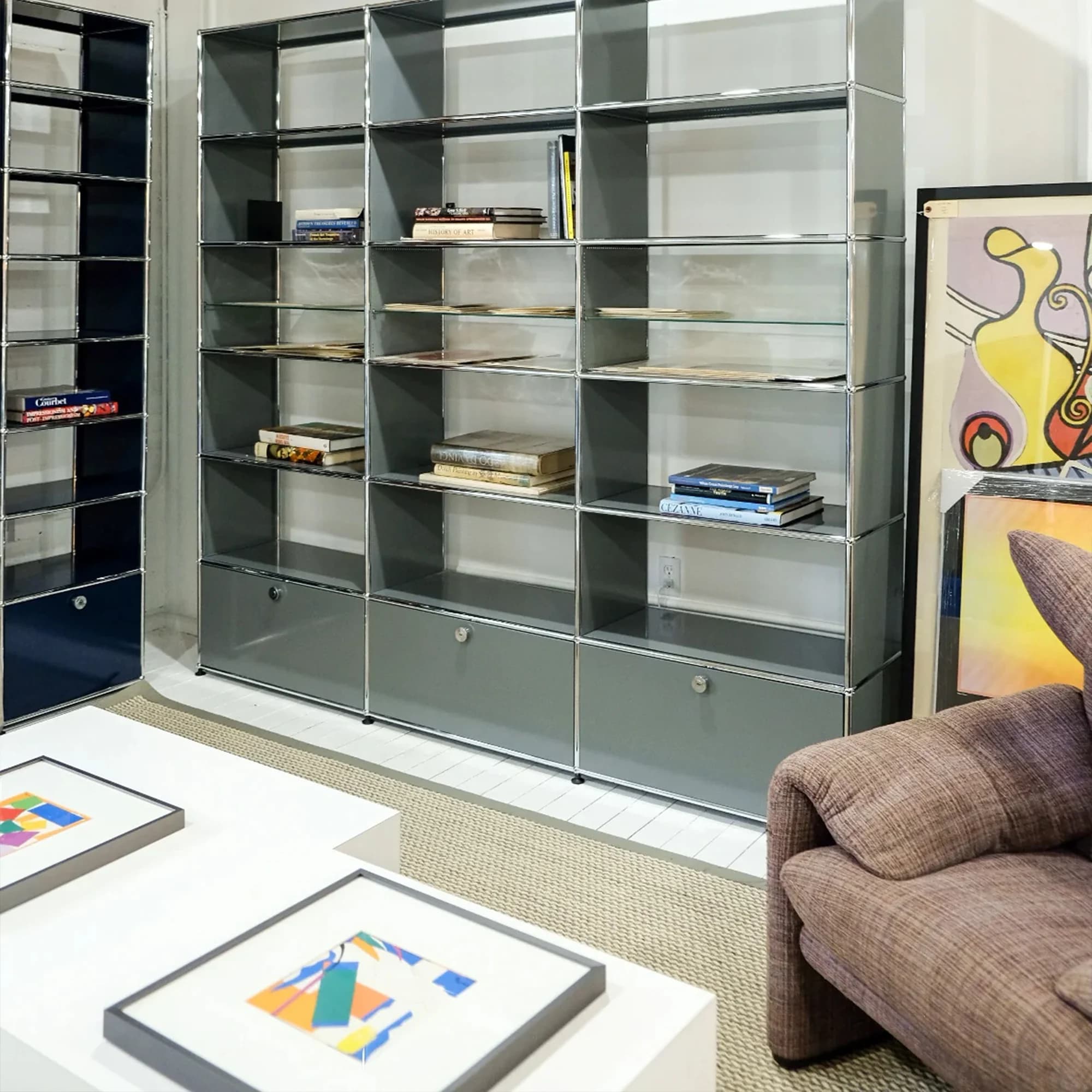
A modular storage system is worth buying when your storage needs will change, and a poor purchase when they will not. The cost sits above a fixed cabinet at the start and below it over ten years, but only if you actually reconfigure. This guide covers how to size a system, what to buy first, and the mistakes that turn a flexible system into an expensive fixed one.

What Counts as a Modular Storage System?
A modular storage system is storage assembled from interchangeable components on a shared grid: frames, shelves, doors, drawers, and panels that can be rearranged after purchase.
The word “modular” appears on a lot of furniture that is not modular. Two questions separate the real thing from the label:
Can you buy a single component two years from now and have it fit? If expansion means buying a second complete unit and standing it next to the first, the system is not modular. It is stackable. The same test applies across every category of modular furniture, not just storage.
Does taking it apart damage it? If disassembly strips the fixings, you get one rebuild, not many.
For how the connections work mechanically, and why the connector type determines load capacity, see our guide to modular shelving systems. This article covers the buying decision instead.
What Does a Modular Storage System Really Cost?
The sticker price is the wrong comparison. Compare the cost of the next ten years.
| Scenario | Fixed furniture | Modular system |
|---|---|---|
| Initial purchase | Lower | Higher |
| Needs change at year 3 | Buy replacement unit | Buy components |
| Move to a new home | Often replaced | Rebuilt to fit |
| One shelf damaged | Replace whole unit | Replace that part |
| Ten year total | Two or three units | One system plus additions |
The break even point depends entirely on how often the layout changes. Someone who buys once and never moves will spend less on a fixed cabinet. Someone who has moved twice in five years will usually spend less on a system.
Two costs that buyers routinely forget:
Expansion is not proportional. Adding a bay to an existing frame costs less than the first bay, because you already own the end supports. The second purchase is usually cheaper per shelf than the first.
Colour availability is a real cost. If a finish is discontinued, expanding means either mismatching or replacing panels you already own. Systems using a standard colour reference, such as the RAL range, protect against this better than proprietary finishes.
How Do You Size a Modular Storage System?
Measure the contents before the room. Most sizing mistakes come from planning around wall space rather than around what goes in it.
Step 1. Measure the tallest item you own. Not the average. A single item that does not fit forces a compromise across the whole unit.
Step 2. Measure total shelf length, not volume. Books, records, and files are stored in a line. Add up the linear length of what you own, then add 25 percent.
Step 3. Decide the split between open and closed. This changes which components you buy, and it is more expensive to change later than to decide now.
Step 4. Check the depth against your deepest item. Depth is the dimension buyers check last and regret first. A unit that is 4 cm too shallow for a record sleeve or an AV receiver cannot be fixed by rearranging.
Step 5. Leave one bay empty on delivery day. A system that is full when it arrives is a system that needs extending within a year.

Open Shelving or Closed Storage?
| Open shelving | Closed storage | |
|---|---|---|
| Access speed | Immediate | One extra motion |
| Dust | Collects on contents | Contained |
| Visual weight in a room | Lighter | Heavier |
| Suits | Books, records, display objects | Documents, cables, clutter |
| Cost per module | Lower | Higher |
| Changing your mind later | Add doors | Remove doors |
Most rooms want both. A common pattern that works: closed storage at the bottom where clutter accumulates and is seen at eye level from a seated position, open shelving above where contents are on display.
Units like the C14 Storage and G118 Storage combine both in one frame, which avoids buying two separate pieces to achieve the same split.
Which Room Should You Start With?
If the budget covers one system, start where the storage problem is worst and the layout is least settled.
Home office. Usually the strongest case. Work setups change often, cable management benefits from closed compartments, and documents need a mix of filing and display. An A1 Desk Unit paired with adjacent storage handles both.
Living room. The second strongest. Media equipment changes on a shorter cycle than furniture, and the demands on a media unit five years from now are not predictable today.
Bedroom. Lower priority for modular specifically. Bedroom storage needs change slowly, and a wardrobe is often the better spend.
Kitchen and utility. Usually the weakest case for a steel display system. Different materials and different requirements.
What Do Buyers Get Wrong?
Buying for the room you have, not the room you will have. The reason to pay the modular premium is future change. Sizing exactly to a current alcove forfeits that.
Treating load ratings as a single number. Check whether a rating is per shelf or per unit, and whether it assumes evenly distributed weight. The difference is large.
Assuming any component fits any system. Modular is not a standard. Grids differ between manufacturers, and components are rarely cross compatible. The system you choose is the system you are committed to for expansion.
Skipping the depth check. Repeated because it is the most common expensive mistake.
Buying all of it at once. A system bought in stages teaches you what you actually need. The first configuration is rarely the right one, and that is fine when the parts can move.
When Does Modular Storage Stop Making Sense?
Three honest cases.
A fixed alcove that must be filled exactly. Grid increments will leave a gap. Built in joinery solves this properly and usually costs less than fighting the grid.
Storage that will never be seen. Garage, loft, basement. Pay for utility shelving instead. The engineering that makes a modular system worth its price is wasted where appearance does not matter.
A single, known, permanent need. One set of books in one room in a house you own and will not leave. Buy a good fixed bookcase.
How Do You Expand Without Mismatching?
Record what you bought. Colour reference, component list, order date. Two years later this is the difference between a matching extension and a visible seam.
Buy the frame you might need, not only the one you need. Extending width usually means adding to an end support you already own. Planning the eventual width at the start costs nothing extra now.
Check finish availability before you commit to a colour. A standard reference like RAL survives longer than a seasonal shade.
Add mobility rather than rebuilding. If a unit needs to move between rooms rather than change shape, a swivel castor set is cheaper than reconfiguring.
The Arvhi configurator produces a component list before ordering, which makes the record keeping above automatic. The shelving and storage collection shows configurations that already work if you would rather start from a known layout.
Frequently Asked Questions
Is a modular storage system cheaper than buying separate furniture? Not initially. It becomes cheaper only if the layout changes, because components are added rather than whole units replaced.
Can modular storage systems be extended years later? Yes, provided the manufacturer still makes the components and the finish is still available. Standard colour references extend that window.
Are modular storage components interchangeable between brands? Almost never. Modular is a design approach, not a shared standard. Grid dimensions and connectors differ between manufacturers.
How much weight can a modular storage shelf hold? It depends on the connector and the frame. Arvhi shelves are rated to 50 kg each. Always check whether a stated rating is per shelf or for the whole unit.
Should I buy the whole system at once or build up? Building up in stages is usually better. The first configuration is rarely the final one, and buying in stages spreads cost while you learn what you actually need.