
Metal Media Consoles: Why Steel Beats Wood for AV Equipment
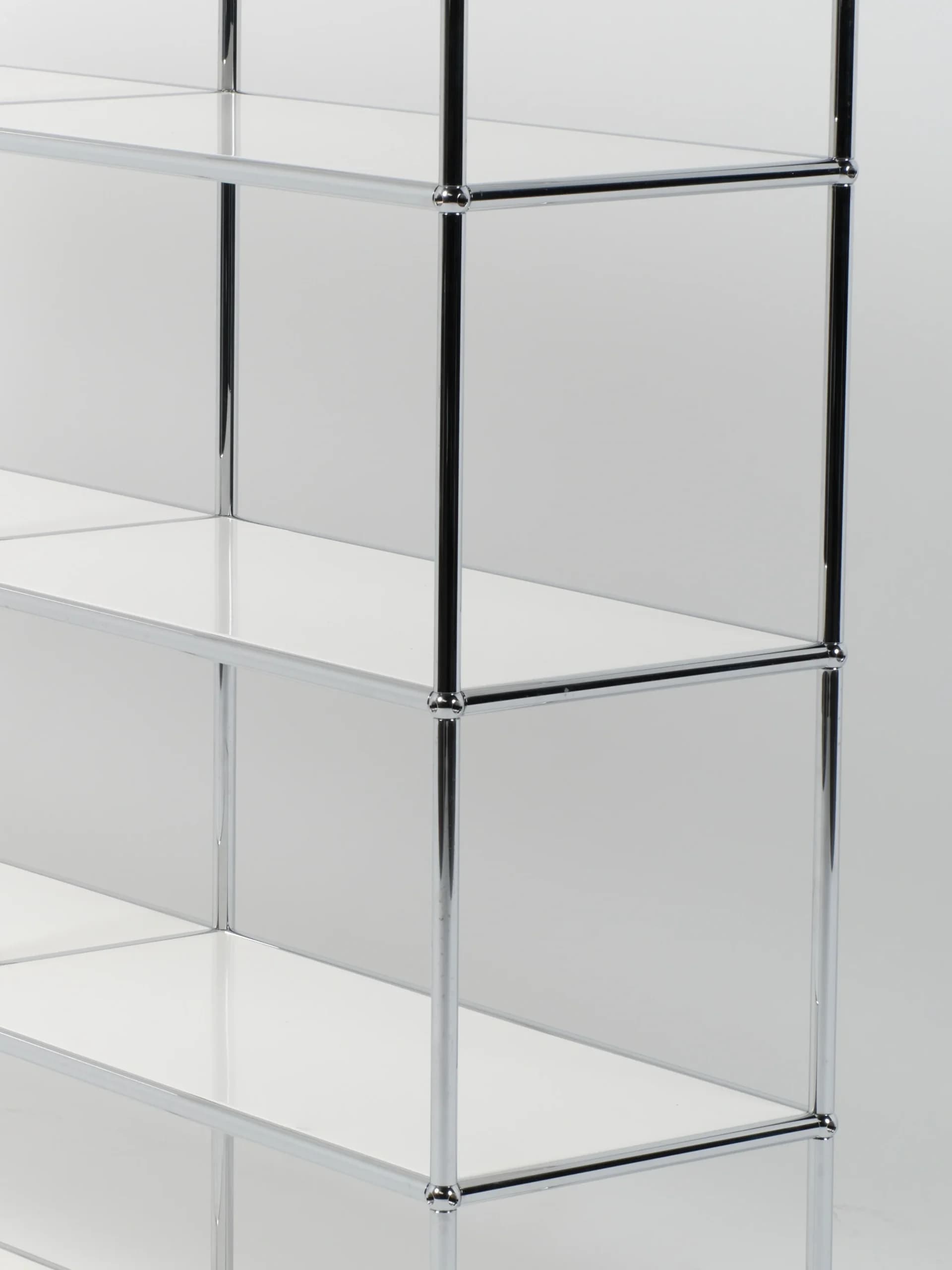
A metal media console holds heavy AV equipment without sagging, stays dimensionally stable near warm electronics, and does not swell if a drink is spilled on it. Wood looks warmer and costs less. The choice comes down to what sits on the shelf: if the equipment is heavy, hot, or expensive, the structural argument favours steel. This guide covers load, heat, vibration, and the real downsides.

Why Does the Material Matter for a Media Console?
Most furniture material choices are aesthetic. Media furniture is one of the few cases where the material changes how the piece performs.
Three demands make it different from a sideboard or a bookcase.
Concentrated weight in the middle. A television, an amplifier, and a turntable are dense objects placed near the centre of a span. That is the worst case for shelf deflection.
Continuous heat. An AV receiver under load runs warm for hours. Adhesive bonded boards are more sensitive to sustained warmth than steel is.
Long service life with changing contents. Equipment is replaced on a shorter cycle than furniture. A console bought today will hold devices that do not exist yet.
Steel vs Wood for Media Furniture
| Steel frame | Solid wood | Particleboard or MDF | |
|---|---|---|---|
| Sag under sustained load | Negligible at normal spans | Low, varies by species and thickness | The common failure mode |
| Behaviour near warm equipment | Dimensionally stable | Can move with humidity | Adhesive is the weak point |
| Moisture and spills | Powder coated surface wipes clean | Can stain or swell | Swells, usually permanent |
| Cable routing | Open frames make it straightforward | Requires cut outs | Requires cut outs |
| Weight of the unit itself | Moderate | Heavy | Light |
| Visual character | Minimal, industrial | Warm | Depends on the finish applied |
| Repair | Replace a component | Refinish | Usually replace the unit |
Solid wood is a legitimate choice and performs well. The comparison that matters in most price brackets is steel against particleboard, because that is what most affordable media furniture is actually made of. A veneer that looks like oak is often 16 mm of bonded board underneath.
Will a Metal Console Sag Under a Heavy Television?
At normal spans, no. This is the clearest practical advantage.
Sag in furniture is a function of span, material stiffness, and load. Steel is substantially stiffer than board of the same thickness, so a steel supported shelf deflects less under the same weight.
Arvhi shelves are rated to 50 kg (about 110 lb) per shelf. For reference:
| Equipment | Approximate weight |
|---|---|
| 65 inch television | 20 to 30 kg |
| AV receiver | 8 to 15 kg |
| Turntable | 5 to 12 kg |
| Subwoofer | 10 to 25 kg |
| Games console | 3 to 5 kg |
Two questions to ask about any load rating, because they change the answer significantly:
Is the rating per shelf or per unit? A console rated 150 kg across three shelves is very different from one rated 50 kg on each of three.
Does it assume evenly distributed weight? Ratings normally do. A television on a stand concentrates its mass on a small footprint, which produces more deflection than the same weight spread across the shelf.
Does Metal Handle Heat Better Than Wood?
Partly, and the reason is usually construction rather than material.
An AV receiver needs airflow. The most common cause of thermal shutdown is not the shelf material but an enclosed cabinet with no ventilation. Open frame metal systems solve this by not enclosing the equipment at all.
Where material does matter: steel is dimensionally stable across the temperature range that home electronics produce. Engineered boards are held together with adhesive, and sustained warmth is harder on adhesive than on steel.
The practical guidance is the same either way. Leave clearance above and behind anything that gets warm, and do not put a receiver in a closed compartment without ventilation regardless of what the compartment is made of.

What About Chrome and Other Metal Finishes?
Metal media furniture usually comes in one of three finishes, and they behave differently in daily use.
| Finish | Look | Practical notes |
|---|---|---|
| Chrome plated | Reflective, bright | Shows fingerprints on flat surfaces. Best on frames and tubes rather than large panels |
| Powder coated | Matte or gloss colour | Scratch resistant, wipes clean, widest colour range |
| Stainless steel | Brushed, industrial | Very durable, limited colour options |
A common and effective combination is a chrome plated frame with powder coated panels. The frame carries the structural load and the reflective detail, while the panels provide colour and a surface that does not show every fingerprint. That is the construction Arvhi uses across its media units.
If a chrome credenza or chrome sideboard is what you have in mind, the same logic applies. Chrome on the frame reads as bright and light; chrome across a large flat door will need cleaning constantly.
Does a Metal Console Cause Vibration Problems?
This is the honest counterargument, and it matters most for turntables.
Any rigid structure can transmit vibration. A metal frame is not inherently worse than a wooden one, and rigidity generally helps rather than hurts, because a stiff support resists movement from footfall and speaker output.
What actually matters for a turntable:
Rigidity of the support. A stiff frame is better than a flexible one. Steel performs well here.
Isolation between the turntable and the shelf. This is handled by the turntable’s own feet or by an isolation platform, not by the furniture material.
Distance from the speakers. More important than either of the above.
If vinyl is the priority, place the turntable on the most rigid part of the unit, which is usually the shelf closest to a joint rather than the middle of the longest span. For record storage specifically, shelf depth is the specification to check, since 12 inch sleeves need to stand upright without leaning. Our guide to record storage furniture covers the exact dimensions a collection needs.
What Are the Real Downsides?
Four, stated plainly.
Cost. A steel frame system costs more than a particleboard console of the same dimensions. If the console will hold a small television and nothing else, that premium buys capacity you will not use.
Visual warmth. Steel and powder coating read as minimal or industrial. In a room built around warm timber and soft textiles, that can feel cold. No colour option fully changes this.
Weight. A steel frame unit is heavier than flat pack. Moving it within a room usually needs two people, or castors.
Fingerprints on chrome. Only an issue on large flat chrome surfaces, and avoidable by choosing powder coated panels.
What Should You Check Before Buying?
1. Depth against your deepest component. Measure the receiver including thecable bend at the rear. This is the most common expensive mistake.
2. Height clearance for ventilation. Leave room above anything that runswarm.
3. Load rating, per shelf. Confirm whether the figure is per shelf or forthe whole unit.
4. Cable routing. Open frames handle this without modification. Closedcabinets need existing cut outs, and cutting them yourself voids most warranties.
5. Whether it can change later. Equipment changes faster than furniture.A console built on a modular system can be extended or reconfigured when the setup does.
Units like the B218 Media, O2 Media, and C13 Media are built on the same frame system, so components move between them. The Arvhi configurator shows the component list for a given layout before ordering.
Frequently Asked Questions
Is a metal media console better than a wooden one? For heavy or warm equipment, yes, because steel resists sag and stays dimensionally stable. For light loads and a warm interior, wood is a reasonable choice at lower cost.
How much weight can a metal media console hold? It depends on the frame and connectors rather than the material alone. Arvhi shelves are rated to 50 kg each. Check whether a stated rating is per shelf or per unit.
Will a metal TV stand scratch? Powder coated surfaces are scratch resistant and wipe clean. Chrome plated surfaces show fingerprints more readily than scratches.
Does a metal console interfere with wireless signals? Not in normal use. A metal shelf is not an enclosure, and open frame construction leaves signal paths clear. Fully enclosing a router inside a sealed metal box would be a different matter.
Can a metal media console hold a turntable? Yes. Rigidity helps rather than hurts. Isolation is handled by the turntable’s feet or a platform, not by the furniture material.
Is stainless steel better than powder coated steel? For durability in humid conditions, yes. For colour choice and fingerprint resistance, powder coating is better. Most home interiors are better served by powder coating.