
Record Storage Furniture: What Actually Fits a 12 Inch LP
A record cabinet needs at least 13 inches of internal depth and height to hold a 12 inch LP upright, because the sleeve measures 12.375 inches square before you add an outer sleeve. Most furniture sold as record storage is built to 12 inches, which is why sleeves stick out or lean. This guide covers the dimensions that matter, how much a collection weighs, and why upright storage is not optional.
What Dimensions Does Record Storage Actually Need?
The single most useful number in this article: a standard 12 inch LP jacket measures 12.375 inches (31.4 cm) square. The record inside is 12 inches. The jacket is not.
| Measurement | Requirement | Why |
|---|---|---|
| Internal depth | 13 inches (33 cm) minimum | Jacket is 12.375 in, plus an outer sleeve, plus room to get fingers behind |
| Internal height | 13 inches (33 cm) minimum | Same dimension, records stand upright |
| Shelf span | Whatever suits, within load limits | Longer spans hold more but deflect more |
Furniture built to a round 12 inches does not fit records. It fits a record with the jacket protruding, which defeats the purpose and damages sleeve edges over time.
This is the specification to check before anything else, and it is the one most product listings omit. If a listing describes a piece as record storage without stating internal depth, assume it does not fit.
Add extra if you use outer sleeves. Polythene or polypropylene outer sleeves add roughly a quarter inch. Collectors who sleeve everything should target 13.5 inches rather than 13.
How Many Records Fit on a Shelf?
A standard single LP with jacket is roughly 3 to 5 mm thick, depending on whether the jacket is single or gatefold and whether the pressing is 140 g or 180 g.
| Linear shelf space | Approximate LP count |
|---|---|
| 12 inches (30 cm) | 70 to 100 |
| 24 inches (60 cm) | 140 to 200 |
| 36 inches (90 cm) | 210 to 300 |
Gatefolds and box sets reduce these numbers substantially. A collection heavy on double albums can occupy 40 percent more space than the same count of single sleeves.
Do not fill a shelf completely. Records need enough room to be pulled out and returned without forcing. A tightly packed shelf causes sleeve wear at the opening edge, which is the most common avoidable damage to a collection.
How Much Does a Record Collection Weigh?
This is where record storage differs from bookshelf storage, and where cheap furniture fails.
A single LP with jacket weighs roughly 230 to 280 g. That adds up faster than people expect:
| Collection size | Approximate weight |
|---|---|
| 100 LPs | 23 to 28 kg |
| 200 LPs | 46 to 56 kg |
| 500 LPs | 115 to 140 kg |
Records are dense and stored in a continuous line, so the load sits along the full length of the shelf rather than in a few spots. Arvhi shelves are rated to 50 kg per shelf, which covers roughly 180 to 200 single LPs.
Two things to check on any shelf you are considering:
Is the rating per shelf or per unit? A cabinet rated 150 kg total across three shelves cannot take 150 kg on one of them.
What is the shelf made of? Particleboard shelves sag under sustained distributed load, and vinyl is exactly that. The sag is gradual and permanent. This is the most common failure mode in record furniture, and it is why steel framed shelving suits vinyl better than budget board construction.

Why Do Records Have to Stand Upright?
Two separate problems, both avoidable.
Stacking flat causes warping. Records at the bottom of a horizontal stack carry the weight of everything above. Vinyl is a thermoplastic, and sustained pressure deforms it, especially in a warm room. The damage is cumulative and usually permanent.
Leaning causes warping too. Records stored upright but tilted develop a curve over months. A shelf that is partly empty lets the remaining records lean into the gap.
The practical rule: store records vertically, packed firmly enough to stand straight, loosely enough to remove without force. Use dividers or bookends if a shelf is not full.
This is also why shelf height matters as much as depth. A compartment that is 14 inches tall and 13 inches deep holds records properly. A compartment 20 inches tall invites stacking a second layer on top, which reintroduces the problem.
Where Should the Turntable Go?
A turntable can sit on the same unit as the collection, provided two conditions are met.
Rigidity. A stiff support resists movement from footfall and speaker output. Place the turntable near a joint or support rather than in the middle of the longest span.
Isolation. This is handled by the turntable’s own feet or an isolation platform, not by the furniture. No cabinet material eliminates vibration on its own.
Distance from the speakers usually matters more than either. For a fuller treatment of how material affects AV furniture, see our guide to metal media consoles.
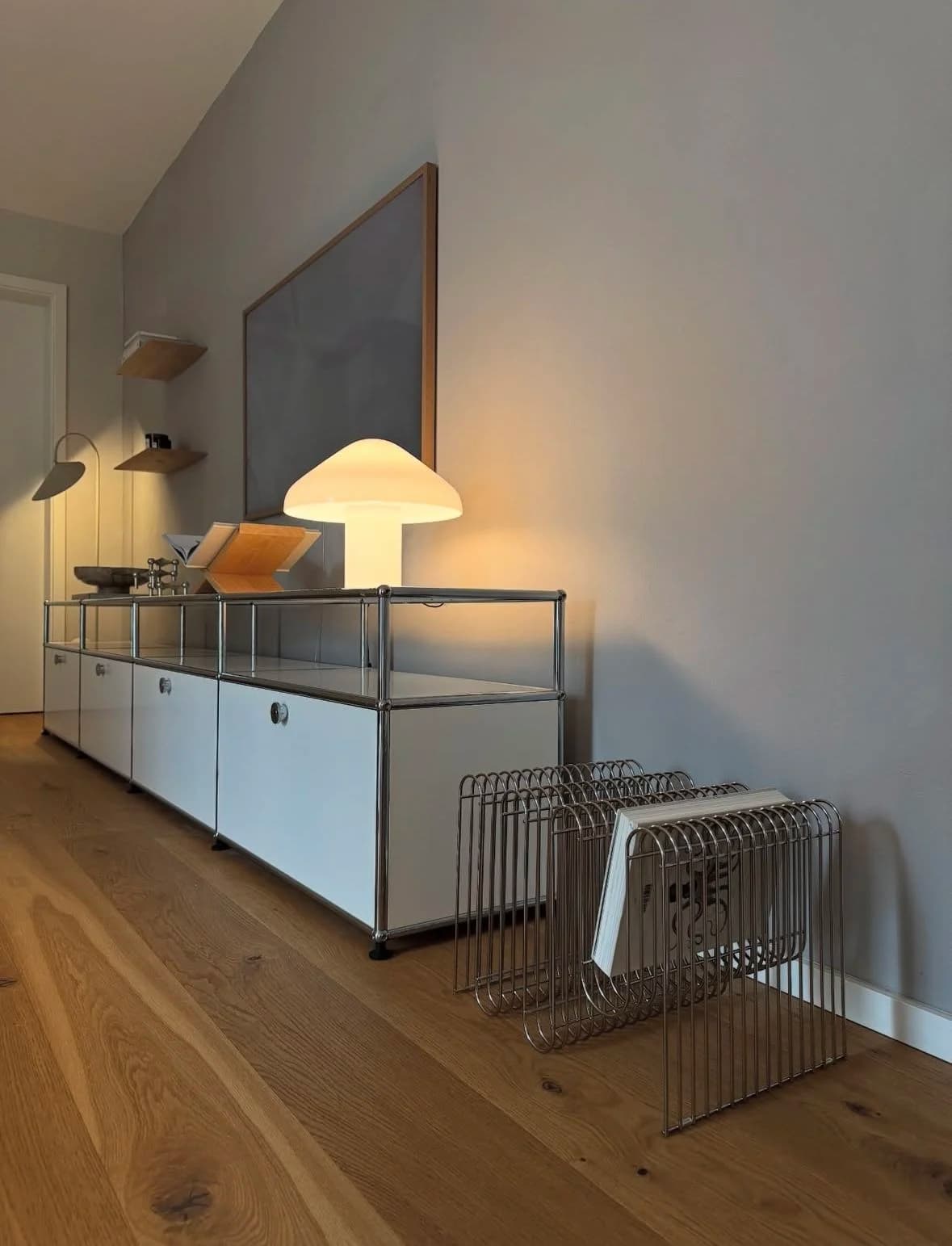
Practical layout that works: turntable on the top surface at a comfortable height for cueing, amplifier on an open shelf with clearance above it, and records in the compartments below where their weight sits low and stabilises the unit.
Open Shelving or a Closed Cabinet?
| Open shelving | Closed cabinet | |
|---|---|---|
| Access while browsing | Immediate | One extra motion |
| Dust on sleeve tops | Collects | Contained |
| Heat around equipment | No issue | Needs ventilation |
| Displaying artwork | Yes | No |
| Cost | Lower | Higher |
Most collectors end up with both: open compartments for the records currently in rotation, closed storage for equipment, cables, and cleaning supplies.
Dust is the argument for doors, and it is a real one. Dust settles on the top edge of sleeves and migrates inside over years. If the room is dusty or the collection is rarely browsed, doors earn their cost.
Heat is the argument against enclosing equipment. An amplifier in a sealed compartment without ventilation will run hot. Records themselves do not need ventilation, but anything electrical does.
What to Check Before Buying
1. Internal depth, stated in inches or cm. Not “fits records”. If thelisting does not state the number, ask.
2. Internal height per compartment. 13 inches minimum, and bewarecompartments so tall they encourage stacking.
3. Load rating, per shelf. Compare against the weight table above usingyour actual collection size.
4. Shelf material. Steel framed or solid timber for sustained load.Particleboard sags.
5. Room to grow. Collections grow. Buy 30 percent more linear space thanyou currently need, or buy a system that extends.
That last point is the case for modular storage. A collection that doubles in five years outgrows a fixed cabinet, and the alternative to extending is replacing.
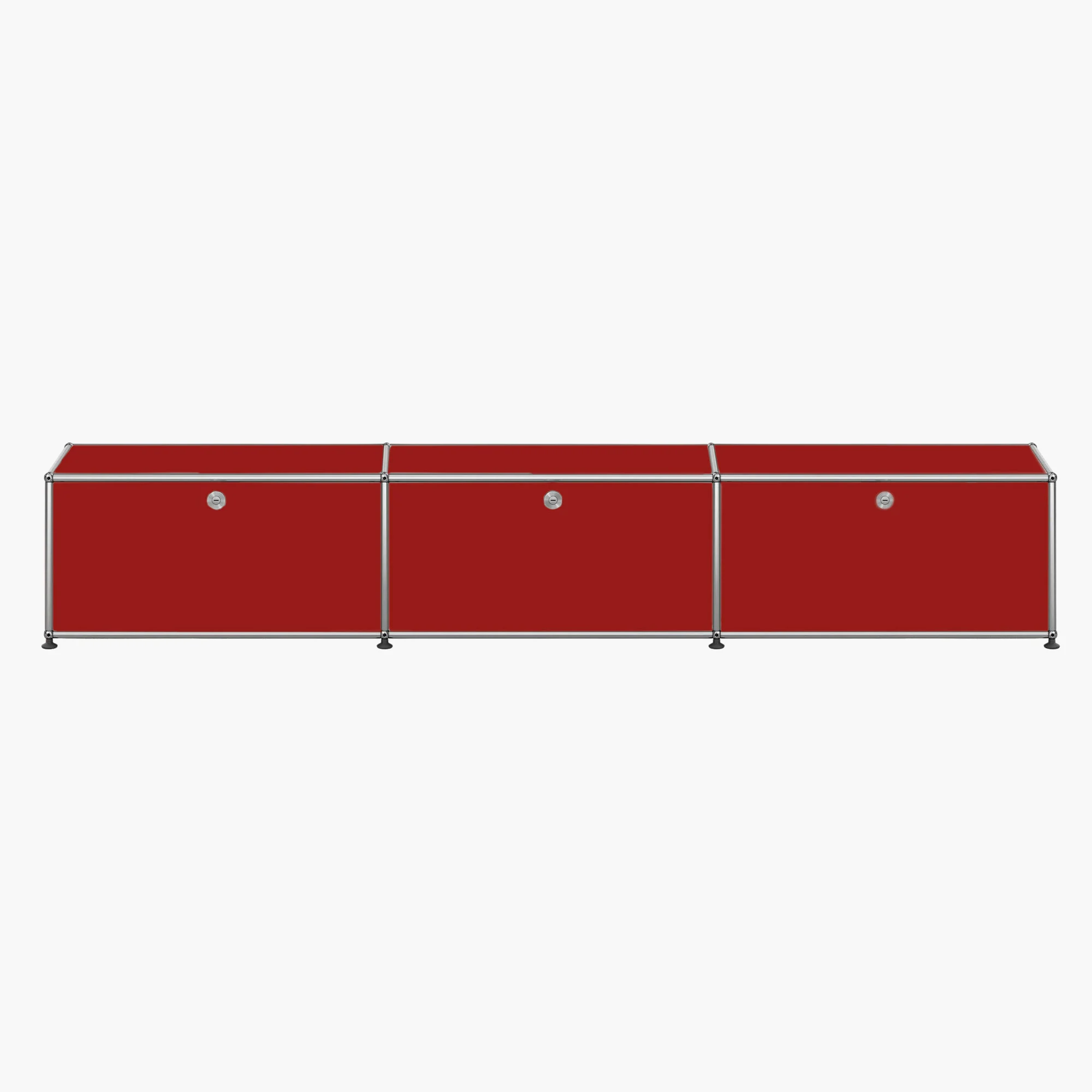
Arvhi media units including the C13 Media, B218 Media, and O2 Media are built on the same steel frame system, so compartments can be added as a collection grows. The Arvhi configurator shows the component list for a layout before ordering.
Frequently Asked Questions
What size should a record cabinet be? At least 13 inches (33 cm) internal depth and height. A 12 inch LP jacket measures 12.375 inches square, so a 12 inch compartment does not fit it.
How many records fit in a foot of shelf space? Roughly 70 to 100 standard single LPs. Gatefolds and box sets reduce this significantly.
How much does a record collection weigh? About 230 to 280 g per LP. A 200 record collection weighs roughly 46 to 56 kg, which is why shelf load rating matters more for vinyl than for books.
Can records be stored flat? Not long term. Records at the bottom of a horizontal stack deform under sustained pressure, and the damage is usually permanent. Store them upright.
Do record cabinets need doors? Doors reduce dust on sleeve edges, which matters over years. They also trap heat around electronics, so any compartment holding an amplifier needs ventilation regardless.
Can a turntable sit on the same unit as the records? Yes. Place it over a support rather than mid span, and handle isolation with the turntable’s feet or a platform rather than expecting the furniture to do it.