
Best Storage for a Small Home Office: Credenza, Cabinet or Shelving?
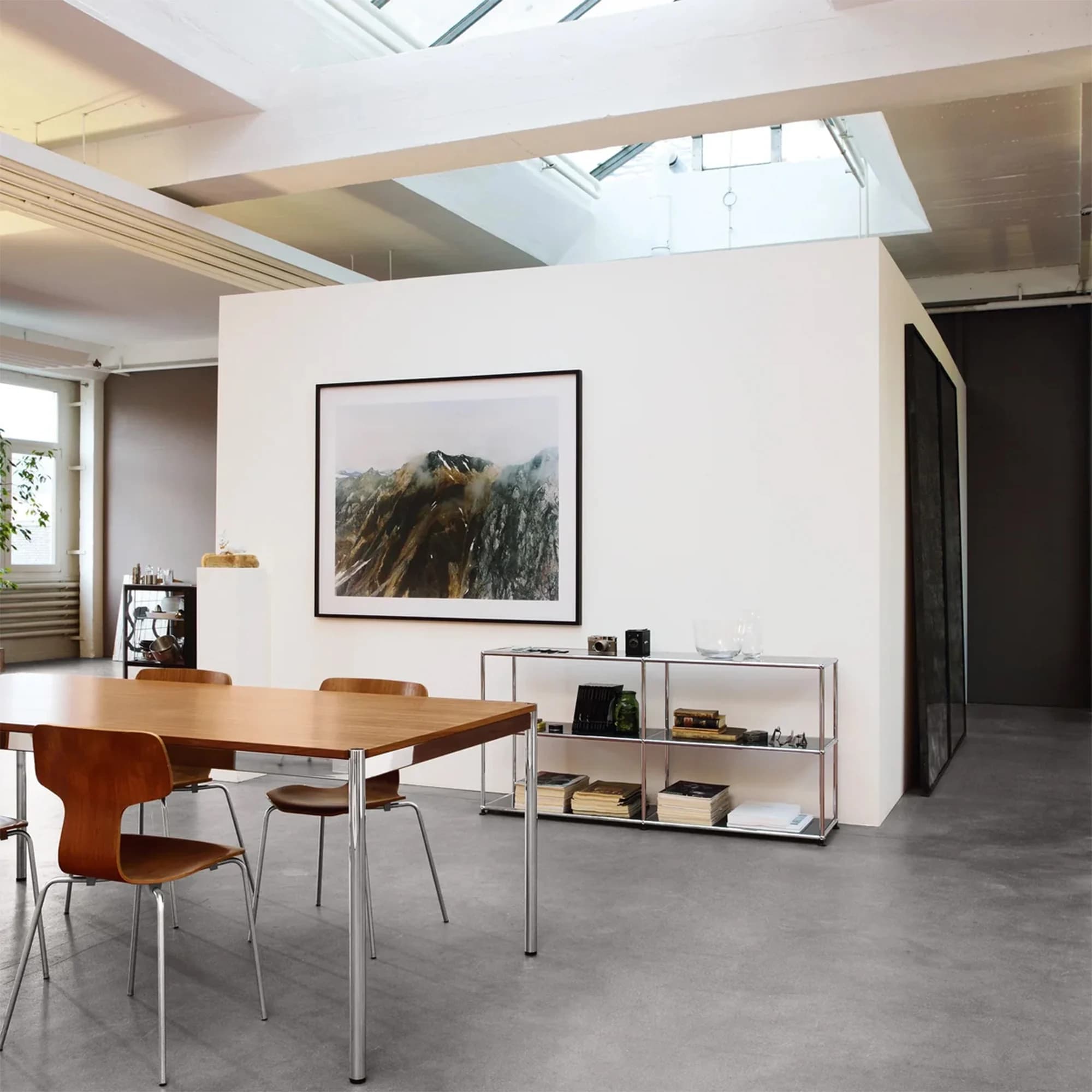
For a small home office, the storage that leaves the most floor is a tall, narrow closed cabinet: an M52 Cabinet covers 0.20 m² (2.1 sq ft), against 0.58 m² (6.3 sq ft) for a 152.4 cm (60 in) credenza. Beyond floor, choose by what you keep: closed credenzas and cabinets for paper and equipment you want out of sight, open shelving for books you reach for every day. In a 244 x 183 cm (96 x 72 in) room, where the storage goes decides whether 69.8 cm (27.5 in) or 107.9 cm (42.5 in) of clear floor is left in front of the desk.
This guide gives the numbers: which unit fits which kind of storage, how much floor each one takes, and a worked room plan you can copy. We sell the units below, so the specs come from our own product pages, and we say where a unit does not fit the job. This is a fit and dimensions guide, not medical or ergonomic advice.
Which storage fits what you keep?
Start with the things you actually store, not the furniture. The table matches each kind of item to the unit type that suits it and to the Arvhi model that comes closest.
| What you store | Best fit | Why | From our range |
|---|---|---|---|
| Paper in folders or binders you rarely open | Closed cabinet or credenza | Doors hide the clutter. A US Letter sheet is 8.5 x 11 in (21.6 x 27.9 cm), and the storage units are 37.3 to 38.1 cm (14.7 to 15 in) deep overall. Interior depth is not published, so measure your folders against it. | E2 Sideboard, G118 Storage, M52 Cabinet |
| Paper in hanging folders | Filing cabinet with hanging-file drawers | Hanging folders need rails that hold them upright. | None. No unit in our range lists a hanging-file drawer. |
| Books and binders you open every week | Open shelving | Nothing between you and the spine. See our guide to styling an office bookshelf. | M56 Shelving, R1 Shelving |
| Printer, router, cables | Low credenza | The top holds the printer and the closed space below hides the router and cables. We publish no top-panel rating, so check the printer’s weight against the 50 kg (110 lb) per shelf figure. | F2 Credenza, E2 Sideboard |
| Small supplies, chargers, stationery | Unit with a drawer | A drawer keeps small items sorted instead of loose on a shelf. | M63 Rolling Cabinet, a drawer unit on castors. Its product page does not yet list dimensions, so ask for them before ordering. |
| A bit of everything, in a very small room | One tall narrow cabinet | It stores vertically and takes the least floor. | M52 Cabinet |
If you keep paper in hanging folders, buy a filing cabinet; nothing we sell is built for them. If you keep it in binders or boxes, note that we do not publish the interior clearance behind our doors, so ask for it and measure your binders before you order.
How much floor does each unit take?
Floor area is the first number to check in a small office, so the table gives it next to height, width and depth. Prices are current sale prices on arvhi.com as of November 13, 2026, during the Black Friday promotion, and the regular price is roughly double.
| Unit | What it is | H x W x D | Floor area | Sale price |
|---|---|---|---|---|
| F2 Credenza | Low; two drop-down doors over an open shelf | 73.7 x 152.4 x 38.1 cm / 29 x 60 x 15 in | 0.58 m² / 6.3 sq ft | $1,499 |
| E2 Sideboard | Low; four drop-down doors, fully closed | 73.7 x 152.4 x 38.1 cm / 29 x 60 x 15 in | 0.58 m² / 6.3 sq ft | $1,599 |
| M52 Cabinet | Tall and narrow; closed and open compartments | 159 x 52.3 x 37.3 cm / 62.6 x 20.6 x 14.7 in | 0.20 m² / 2.1 sq ft | $1,699 |
| M55 Cabinet | Small; one drop-down door under an open compartment | 56.5 x 52.3 x 37.3 cm / 22.2 x 20.6 x 14.7 in | 0.20 m² / 2.1 sq ft | $799 |
| G118 Storage | Waist height; three closed fronts | 109.2 x 78.7 x 38.1 cm / 43 x 31 x 15 in | 0.30 m² / 3.2 sq ft | $1,299 |
| R1 Shelving | Tall; open shelves over two closed fronts | 179 x 77.3 x 37.3 cm / 70.5 x 30.4 x 14.7 in | 0.29 m² / 3.1 sq ft | $2,199 |
| M56 Shelving | Open shelving | 99.1 x 77.5 x 38.1 cm / 39 x 30.5 x 15 in | 0.30 m² / 3.2 sq ft | $1,199 |
Every unit in this table is 37.3 to 38.1 cm (14.7 to 15 in) deep, so the real difference between them is width and height. Configurations are as pictured on each product page. If you want to see how a layout of your own would look, the configurator lets you build it in 3D.
Worked example: a 244 x 183 cm (96 x 72 in) room
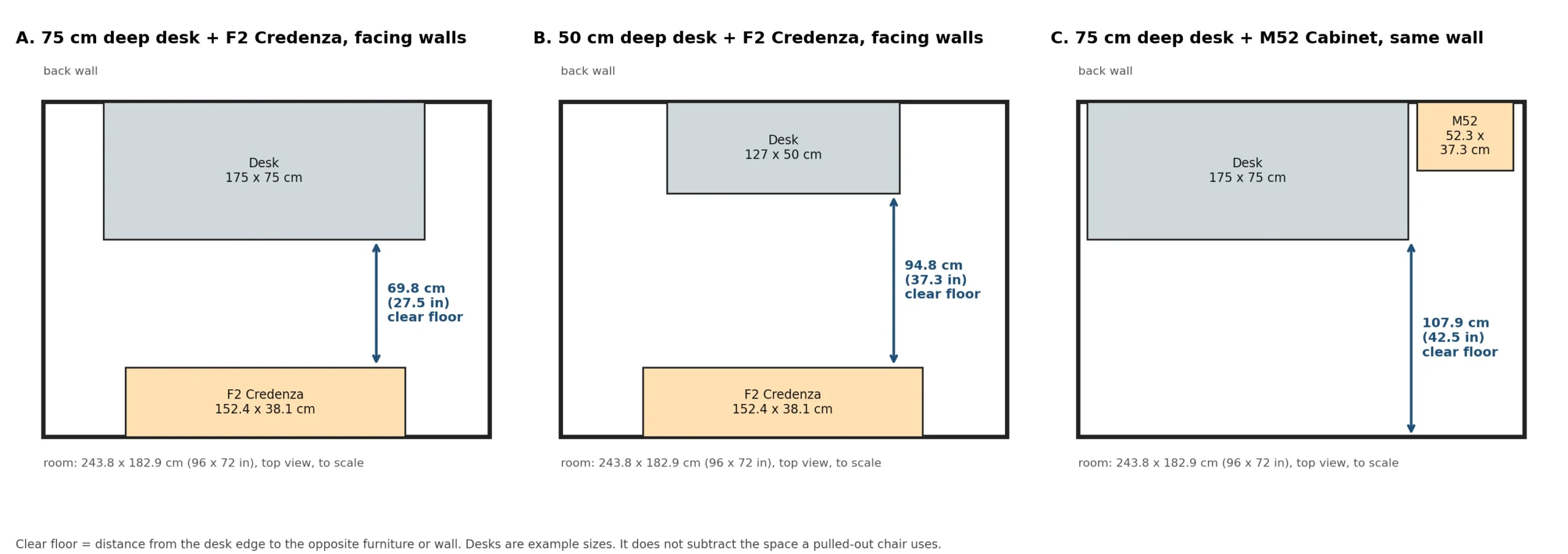
Take a small room 244 x 183 cm (96 x 72 in), about the size of a small spare room or a bedroom nook. The desks are example inputs, 75 cm and 50 cm deep; use your own desk’s depth. We compared three layouts by arithmetic: room depth, minus the desk depth, minus the depth of any storage on the opposite wall, leaves the clear floor in front of the desk. That space has to hold the chair as well as anyone walking past.
| Layout | Calculation | Clear floor in front of the desk |
|---|---|---|
| A. 75 cm deep desk + F2 Credenza, facing walls | 182.9 minus 75 minus 38.1 cm | 69.8 cm / 27.5 in |
| B. 50 cm deep desk + F2 Credenza, facing walls | 182.9 minus 50 minus 38.1 cm | 94.8 cm / 37.3 in |
| C. 75 cm deep desk + M52 Cabinet, same wall | 182.9 minus 75 cm | 107.9 cm / 42.5 in |
Layout A is the one most people draw first: a full-size desk with a credenza on the opposite wall. In this room it leaves 69.8 cm (27.5 in) between the desk edge and the credenza, and the chair has to fit in that space. Layout B gains 25 cm with a shallower desk, and layout C gains 38.1 cm by putting storage beside the desk instead of across from it. The M52 Cabinet uses 52.3 cm of the back wall, so a desk up to about 190 cm wide still fits beside it on a 243.8 cm wall.
These figures do not subtract the space a pulled-out chair uses, and they assume nothing else stands in that strip. If a path past the desk has to stay open, the 2010 ADA Standards give 36 in (91.5 cm) as the minimum clear width for a walking surface on an accessible route. That rule covers public and commercial buildings, not homes, so treat it as a reference, not a pass mark. Our desk height guide covers the desk side of the same room.
Credenza, cabinet or shelving: what you give up with each
Credenza (F2, E2). It is low, so a wall above it stays free. We publish no top-panel load rating, so check the weight of anything you put on top. It is wide, at 152.4 cm (60 in), so it only fits where you have a clear wall that length. For a longer comparison of the low units, see sideboard vs buffet vs credenza.
Tall units (M52, R1). They use the least floor for their storage height: the M52 is 52.3 cm (20.6 in) wide and 159 cm (62.6 in) tall, and the R1 is 77.3 cm (30.4 in) wide and 179 cm (70.5 in) tall, with open shelves above two closed fronts. The trade is that everything sits vertically, and there is no flat surface at desk height for a printer.
Shelving (M56). Shelving keeps reference material in reach. The cost is that what sits on it is visible, which suits books and not cables or loose paper. Each shelf is rated for up to 50 kg (110 lb), as covered in our shelf load capacity guide.
If you cannot decide, a mix is normal: one closed unit for what you want hidden and one open unit for what you use. Our modular storage buyer’s guide covers sizing a whole system.
Which unit we would pick for three common rooms
- A desk in a bedroom corner. An M52 Cabinet beside the desk. It covers 0.20 m² (2.1 sq ft) of floor and adds 52.3 cm (20.6 in) to the wall the desk stands on.
- A dedicated small spare room. An M52 Cabinet on the desk wall, as in layout C, with M56 Shelving on a side wall for books.
- A shared living room. An E2 Sideboard, closed on all four fronts, so paper and cables stay out of sight; an F2 Credenza if you want one open shelf. See the credenza collection and the cabinet collection.
Starting with one unit and adding later
Our units are built on ball joints, so you can add or rearrange modules later instead of replacing the whole piece. Start with the one unit your room needs now and add to it when the paper or the books grow. Every purchase has a 5-year warranty. You can browse by room in the home office collection.
Frequently asked questions
What is the best storage for a small home office?
It depends on what you keep. Closed credenzas and cabinets suit paper and equipment you want out of sight, open shelving suits books you reach for every day, and a tall narrow cabinet uses the least floor. An M52 Cabinet covers 0.20 m² (2.1 sq ft) of floor, while a 152.4 cm (60 in) credenza covers 0.58 m² (6.3 sq ft).
Is a credenza a filing cabinet?
No. A credenza is a low, wide storage cabinet, and a filing cabinet is built around drawers that hold hanging folders. Some credenzas include file drawers. None of the units in this guide lists a hanging-file drawer, so if you keep paper in hanging folders, check that before you order.
Can a credenza be used as a desk?
As a laptop surface, it can be. The F2 Credenza is 73.7 cm (29 in) high and 38.1 cm (15 in) deep. Measure your laptop, keyboard and any monitor stand against that 38.1 cm depth before you plan to work from it.
How much walking space should a small office keep?
There is no published standard for homes. The 2010 ADA Standards set a minimum clear width of 36 in (91.5 cm) for walking surfaces on an accessible route, which applies to public and commercial buildings, not private homes. Use it as a reference for a path you need to keep open past the desk, and remember that the floor in front of a desk also has to hold the chair.
How much weight can an Arvhi shelf hold?
Our product pages list up to 50 kg (110 lb) per shelf. That is a per-shelf rating. We publish no separate rating for the top panel, so compare the spec-sheet weight of any heavy item, such as a printer, with 50 kg before you place it.
Sources
- U.S. Access Board, 2010 ADA Standards, Chapter 4: Accessible Routes, section 403.5.1 Clear Width: 36 inches (915 mm) minimum.
- ANSI, Standard Paper Sizes: US Letter paper (ANSI A) is 8.5 x 11 inches.
- Arvhi product pages for dimensions, per-shelf load rating and sale prices, as of November 13, 2026.
Dimensions and layouts here are a fit guide and are not medical or ergonomic advice. This item is not manufactured by or affiliated with the original designer(s) and associated parties. We do not claim any rights on any third party trademarks.